

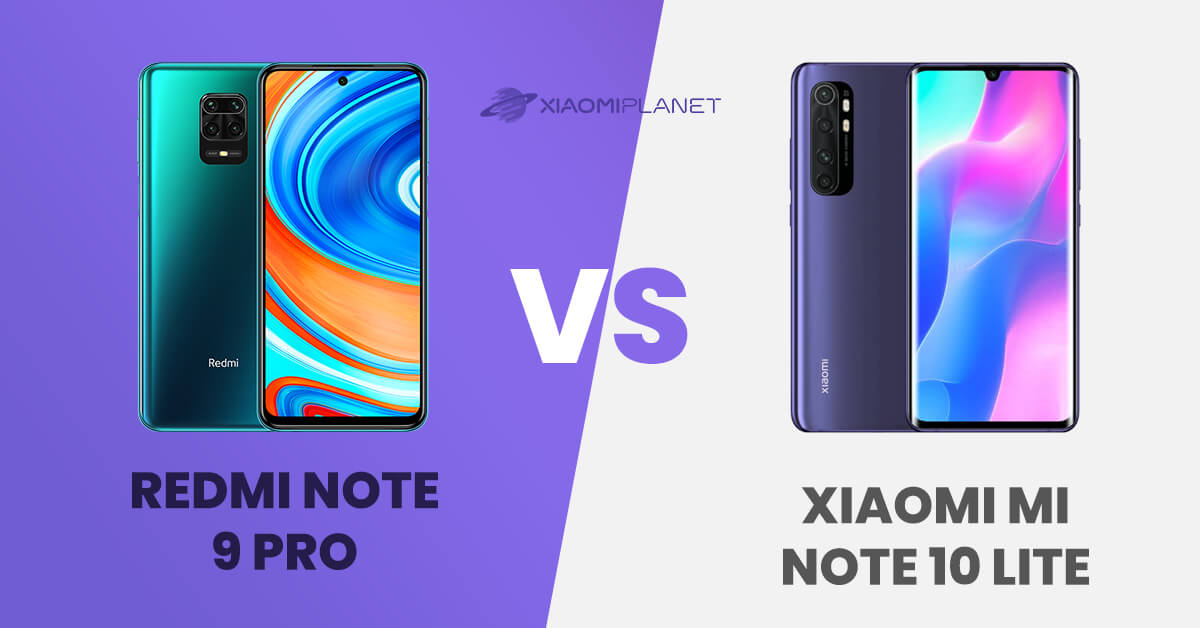
The company Xiaomi and its subsidiary brand Redmi sometimes offer devices that are very competitively priced on the sales market. This is also true for the pair of smartphones Redmi Note 9 Pro and Xiaomi Mi Note 10 Lite.
Both of these Xiaomi/Redmi-branded smartphones were ones we had the chance to test on our website, and we prepared a full-fledged review for them.
But how do they fare in a direct comparison of the most important features? That’s exactly what we’ll try to find out in this comparison article.
Technical specifications: Redmi Note 9 Pro vs Xiaomi Mi Note 10 Lite
The two smartphones don’t just share a similar price—they also have very similar technical specifications. We’re increasingly seeing questions from our readers that focus exactly on these two smartphones and the dilemma of which one to choose in the end.
| Redmi Note 9 Pro | Xiaomi Mi Note 10 Lite | |
|---|---|---|
| Dimensions | 165.8 x 76.7 x 8.8 mm | 157.8 x 74.2 x 9.7 mm |
| Weight | 209 g | 204 g |
| Used material | Glass-Plastic | Glass-Aluminum |
| Display | IPS LCD / 6.67 inches | AMOLED / 6.47 inches |
| 1080 x 2400 px 20:9 | 1080 x 2340 px 19.5:9 | |
| 395 ppi density | 398 ppi density | |
| Gorilla Glass 5 | Gorilla Glass 5 | |
| Fingerprint sensor standard on the side frame | Fingerprint sensor: optical in the display | |
| LED notifications | Yes | Yes |
| Processor | Snapdragon 720G | Snapdragon 730G |
| Graphics | Adreno 618 | Adreno 618 |
| Measured performance in AnTuTu | 274 596 points | 264 493 points |
| 4G LTE band support B20 | Yes | Yes |
| Primary camera | 64 MPx | 64 MPx |
| Aperture f/1.9 | Sensor size 1/1.72″ | 0.8 µm | Aperture f/1.9 | Sensor size 1/1.72″ | 0.8 µm | |
| Laser/PDAF autofocus | Laser/PDAF autofocus | |
| 4K 30 fps video | 4K 30 fps video | |
| Secondary cameras | 8 MPx ultra-wide | f/2.2 aperture | 1.12 µm | 8 MPx ultra-wide | f/2.2 aperture | 1.12 µm |
| 2 MP depth sensor | aperture f/2.4 | 5 MP depth sensor | aperture f/2.4 | |
| 5 MP macro | aperture f/2.4 | AF | 2 MPx macro | aperture f/2.4 | |
| Front camera | 16 MPx | 16 MPx |
| Aperture f/2.5 | 1.0 µm | Aperture f/2.5 | 1.0 µm | |
| SD Card | Yes – microSDXC – dedicated slot | No |
| 3.5 mm jack | Yes | Yes |
| Infraport | Yes | Yes |
| NFC | Yes | Yes |
| Radio | Yes + recording | Yes + recording |
| Battery | Li-Po 5020 mAh | Li-Po 5260 mAh |
| Fast charging 30 W | Fast charging 30 W | |
| Wireless charging – NO | Wireless charging – NO | |
| Enhanced durability | - | - |
Display: IPS LCD vs AMOLED
The display panel, or the screen, is one of the most important criteria when buying a new smartphone. Of this pair, the Mi Note 10 Lite clearly comes out on top—thanks to the 6.47″ AMOLED panel. The competing Redmi model offers a larger 6.67″ panel, but it’s an IPS LCD type.

Xiaomi’s premium AMOLED panel is definitely a step forward, while in other parameters like resolution, aspect ratio, or narrow bezels, the two smartphones are very similar.
The Redmi smartphone’s IPS display takes up almost 85% of the front, while the AMOLED on the Mi Note 10 Lite model covers up to almost 88% of the front.
Performance: Snapdragon from the 700 series
On the performance side, the Xiaomi model is again the winner. It uses a powerful processor labeled Snapdragon 730G, which has become especially popular in the mid-range smartphone segment.

The Redmi model offers the Snapdragon 720G processor. This model scores a slight advantage of a few thousand points in AnTuTu, but generally it’s an older processor from Qualcomm’s lineup with different components compared to the 730G model mentioned above.
Camera: in both cases 64 MPx
When it comes to photo capabilities, those are also very important. In both cases, we get a 64 MPx main sensor with laser autofocus.
It’s also the case that both are paired with a very good 8 MPx ultra-wide-angle lens. The difference mainly shows up in the secondary cameras for macro and depth shots.

Here, the difference can be seen especially in the resolution, and the Redmi model has a slight edge with its 5 MPx macro lens. However, these are cameras that are used very rarely, and with support for 4K video plus a 16 MPx camera on both smartphones, we can call this category a tie.
Battery: over 5000 mAh
The Redmi Note 9 Pro battery offers a capacity of 5020 mAh. That’s definitely not a bad value, and thanks to the power-efficient processor you can expect a comfortable two days of battery life on a single charge. An even higher battery capacity is offered by the Mi Note 10 Lite. The capacity of this model tops out at 5260 mAh.

Besides the high battery capacity, charging speed is also crucial. In both cases, you get a fast charger directly in the box with total output of 30W.
Price and availability
If the specs don’t decide, the product price definitely does. In this case, the Redmi Note 9 Pro model currently goes for around 180 € / 215 USD. That’s definitely a very tempting offer given this smartphone’s equipment.
Redmi Note 9 Pro Global


TIPExpress delivery from a Polish warehouse without customs duty and VAT.
This product will be delivered to you express from a local Polish warehouse. Shipping from Poland usually takes 7-10 days and is handled by a courier. On delivery, you won’t pay any extra fees—no customs duty and no VAT.

TIPExpress delivery from a Polish warehouse without customs duty and VAT.
This product will be delivered to you express from a local Polish warehouse. Shipping from Poland usually takes 7-10 days and is handled by a courier. On delivery, you won’t pay any extra fees—no customs duty and no VAT.
No matter the availability, the model Xiaomi Mi Note 10 Lite won’t leave you embarrassed. Its price is higher, but the quality of the materials and the components used within the technical specifications increases accordingly. The current price from international sellers is around 250 € / 298 USD.
Final verdict: Redmi Note 9 Pro vs Xiaomi Mi Note 10 Lite
Which of these two smartphones should you buy? Considering the very good price/performance ratio, we recommend the Xiaomi Mi Note 10 Lite model. For its price, you get not only a top-tier AMOLED display, but also a larger battery, premium materials, and a Snapdragon 730G processor.


However, if you want to save a few euros and you’re willing to accept a couple of compromises, the Redmi Note 9 Pro will pay off. You’ll have to make do with an IPS LCD display, a Snapdragon 720G processor, and a slightly weaker battery.
Which of these two smartphones would you choose? You can share your opinion in the poll below.
You can also write your thoughts and opinions below in the discussion under the article. If you want more comparisons like this, subscribe to our newsletter. Follow the Xiaomi Planet portal and you’ll learn more information.
Which of these two smartphones would you choose?
Don’t miss the best coupons 📩
Subscribe and we’ll email you new coupons before they expire. We only send it once a month — no spam.
