

It’s December 10, 2019 and the Redmi press conference is still ongoing in China. The new Redmi K30 smartphone was unveiled just a moment ago, and we’re bringing you complete exclusive details among the first.
The new Redmi has grown into beauty
The new Redmi K30 definitely doesn’t belong to the smaller ones, but we have to admit the overall look has again impressed the designers at Redmi. The phone comes in four color variants: blue, pink, red, and white.
Some color variants have a gorgeous, gradient-like look, and depending on the angle of the light, the shades can change.


The front of the Redmi K30 is dominated by a large LCD panel with a “punch-hole” for the front cameras and a thin frame. The phone’s body is rounded on the sides, tapering toward the side edge with a thickness of just 2.44 mm. It’s made from a metal alloy frame in the same color as the phone.

On the right side, a hardware button with a fingerprint sensor is built into the frame. Here, the slim side line slightly widens to enable comfortable, flawless unlocking of the smartphone with a thumb or finger fingerprint.

On the bottom part of the surrounding frame, you’ll find three stylish cut-outs for the speaker and a microphone opening. In the center there’s a USB Type-C connector and a 3.5 mm audio jack for headphones. The tray for two SIM cards combined with the microSD card slot is on the left side of the frame.
On the back, a module with four cameras stacked vertically dominates, placed inside a circle. It has tones the same color as the rest of the smartphone, but structurally it’s separated from the remaining part of the back panel. Under the camera module there’s a dual LED flash.

The device dimensions stop at 165.3 × 76.6 × 8.79 mm, but thanks to design details like gradient-like tones, rounded body edges, a slim side line, and the circular ring around the cameras, it doesn’t feel bulky at all. Redmi K30 weighs 208 g.
Incredible 120 Hz display!
Redmi K30 comes with a large IPS LCD display with a diagonal of up to 6.67 inches. The display covers an area of 107.4 cm2 and makes up 84.8% of the phone’s front. It has a resolution of 2400 x 1080 pixels in an aspect ratio of 20:9. Pixel density is thus 395 pixels per inch. The display is protected by Gorilla Glass 5.

The biggest tech innovation that makes Redmi K30 a pioneer is increasing the display refresh rate up to 120 Hz. Of course, users can also set it to a half value of 60 Hz in the settings—what has been the standard on Xiaomi and Redmi smartphones so far.
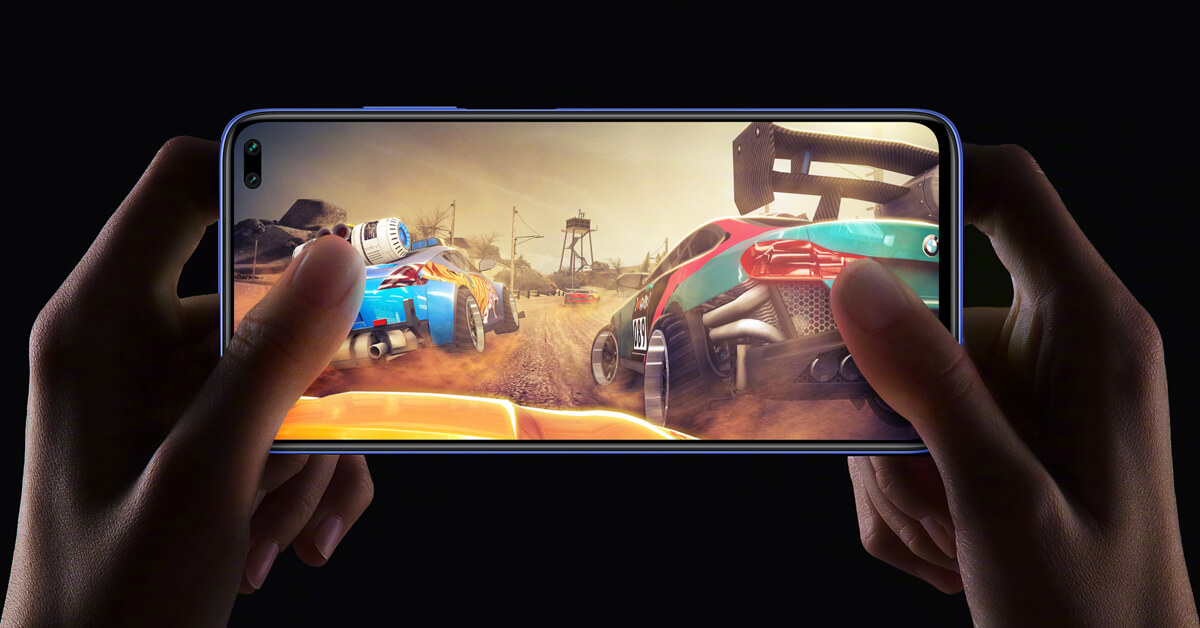
A major innovation we haven’t seen in Xiaomi group smartphones up to now is the placement of the front cameras. First of all, Redmi K30 is the very first smartphone from this brand to feature two front cameras.
To position them, the manufacturer chose an opening rather than a cut-out. The so-called elongated “punch-hole” is located in the top-right corner of the display. It takes up part of the upper notification bar, but we’re already looking forward to the creative background wallpapers that will use it as a graphic element.
4G and 5G version
As announced even before the presentation, the Redmi K30 comes in both the 4G and 5G versions. At first glance, the difference may seem simple, but in reality it’s not. The difference between these two versions will be not only in the networks and price, but also in the internal construction.

Supporting 5G networks in a smartphone requires not only a special modem, but also a more advanced heat dissipation setup, far more antennas, and even a larger mainboard. So Redmi had to invest a significant amount of money to adapt the 4G smartphone to a 5G version, including research and development.
The world’s first smartphone with a Snapdragon 765G
Qualcomm, the chipmaker, introduced a new Snapdragon 765G chipset model with support for 5G mobile networks only recently. Up to now, however, it wasn’t integrated into any smartphone, and the Redmi K30 is the first global device with this processor.
Snapdragon 765G is a 64-bit 7 nm octa-core processor with a core configuration in a 1+1+6 structure. It features a large Kryo 475 Prime (Cortex-A76) core running at 2.4 GHz and another Kryo 475 Gold (Cortex-A76) core running at 2.2 GHz.
The setup is rounded out by six smaller Kryo 475 Silver (Cortex-A55) cores running at 1.8 GHz.

As for the Adreno 620 graphics chip, it promises up to 38% better performance than its predecessor Adreno 618. That a truly powerful combination is at work is confirmed by the performance score achieved in the AnTuTu test, which reaches as much as 302 847 points.
The chipset is bundled with a Snapdragon X52 5G modem, which delivers download speeds of 3.7 Gb/s and upload speeds of 1.6 Gb/s via sub-6 GHz and mmWave. Redmi K30 is the very first smartphone that supports dual 5G technology. This means it can connect to both a standalone 5G SA network and a non-standalone NSA network that runs on an LTE network structure.

To meet user expectations, the Redmi K30 comes with multiple memory versions. Customers will be able to choose between versions with 6 or 8 GB RAM. Storage options will be 64 GB, 128 GB, and 256 GB.
Four rear cameras and dual “selfies” in front
As expected, the phone comes with a total of six cameras. They’re split into 4 rear and two front units. The rear camera lineup looks like this:
- 64 MPx primary sensor Sony IMX 686 Exmor RS CMOS, aperture f/1.89, sensor size 1/1.7″, pixel size 0.80 µm
- 8 MPx ultra-wide sensor with a 120° viewing angle, 1.12 um, aperture f / 2.2,
- 2 MPx depth sensor, aperture f/2.4, sensor size 1/5″, pixel size 1.75µm
- 2 MPx super-macro lens, 1.75 um, aperture f / 2.4, AF

These sensors are complemented by a dual LED flash placed underneath them. The Camera app in MIUI offers a wide range of modes and settings, as well as various filters and scene adjustments even before shooting. Of course, there’s also an AI mode that adapts the Quad camera settings to capture the best possible shot.

Among the additional camera features, you’ll find RAW photos and the Vlog function, which lets users trim video with effects directly on the smartphone, plus a super-night mode from the Xiaomi CC9 Pro (Mi Note 10) model.
A major innovation that arrives for the first time with the Redmi K30 smartphone is the combination of two front cameras. The manufacturer chose to place them in the display cutout that we’ve already described.

The primary front sensor has a resolution of 20 MPx. It has an aperture f/2.2 and a pixel size of 0.8µm. The second one is a 2 MPx sensor—this is a depth sensor with a pixel size of 1.75µm. This combination is capable of recording video at 1080p resolution, 30 frames per second.
Other equipment features also bring upgrades
There’s a 5G MultiLink technology onboard that ensures smooth downloading isn’t hindered by the connection. Thanks to the technology used, the smartphone will support both 2.4 GHz and 5 GHz Wi-Fi connections, as well as 5G mobile connectivity at the same time.

Since we’ve mentioned dual-band WiFi, it’s available in standards 802.11 a/b/g/n/ac. Wireless connectivity is complemented by Bluetooth 5.0 and the popular NFC module for contactless payments.
Another upgrade is using dual technology for location search. This feature mainly improves the speed and accuracy of your position without inaccuracies or dropouts. All available navigation systems are supported, such as GPS, A-GPS, GLONASS, GALILEO and BDS.


At the bottom, there is also an ultra-linear speaker with a new technology that delivers clearer sound, but above all truly high volume. In addition, the already mentioned 3.5 mm audio jack with Hi-Res Audio certification is also present.

The manufacturer built a solid battery into the Redmi K30 with a capacity of 4500 mAh. It supports fast “30W Fast Flash Charge” charging, allowing you to charge the battery from zero to full in just one hour.
Redmi K30 4G version – differences
As expected, the manufacturer also unveiled the Redmi K30 in a 4G version. This one is for customers who can’t or don’t want to use 5G mobile networks. The Redmi K30 4G looks indistinguishable from the more expensive 5G version. On the back, under the dual LED flash, the 5G label is missing—and that’s the only visual difference.

Another difference is the processor. Redmi equipped the 4G version of the smartphone with the Snapdragon 730G chipset, which we know, for example, from the Xiaomi Mi Note 10. It delivers similar performance numbers as the SD765G, but it doesn’t support 5G mobile networks.
The Snapdragon 730G with 64-bit architecture has eight Kryo 470 cores, arranged at a ratio of 2 x 2.2 GHz Kryo 470 Gold and 6 x 1.8 GHz Kryo 470 Silver. The processor was built on 8nm technology for extreme energy efficiency in a small footprint. The same manufacturing process is also used for the flagship processor Snapdragon 855.

The graphics chip is Adreno 618—supports True HDR with extreme realism, rich graphics, and cinematic image processing quality, which is possible for the first time with a Snapdragon from the 7th class. According to the manufacturer, Snapdragon 730G delivers high performance and impressive battery life.
The Redmi K30 4G also charges the 4500 mAh battery a bit more slowly—27W fast charging compared to 30W in the 5G model. Other specs, like the amazing 120 Hz display or the 64 MPx Sony camera, have been kept.
Prices are crazy
Even with the Redmi K30 brand, it confirms its policy of offering the best equipment-to-price ratio. Although the new Redmi K30 smartphone is currently intended only for the Chinese market, its prices are very attractive and affordable.
Redmi K30 4G with 6 GB RAM + 64 GB storage: 1599 yuan – 205 € / 5250 CZK
Redmi K30 5G with 6 GB RAM + 64 GB storage: 1999 yuan – 256 € / 6550 CZK
Will there also be a global version?
Nothing was said today about a global version of the Redmi K30, but we believe it won’t take long and the smartphone will be available for us too. Possibly under another name (Xiaomi Mi 10T?) and likely with a different price tag—but we believe we’ll be able to try this new model soon.
If the Redmi K30 is available in a global version, we’ll send you an email. ?
Don’t miss the best coupons 📩
Subscribe and we’ll email you new coupons before they expire. We only send it once a month — no spam.