

Redmi Note 9S
Our editorial rating based on product testing.
- Great photo results
- 5020 mAh battery
- High-quality workmanship
- Fast fingerprint reader
- No NFC
- Dimmer maximum display brightness
The Redmi Note 9S smartphone delivers a very interesting price/performance ratio thanks to its specs. You get not only a large 6.67″ IPS panel, but also a modern punch-hole cutout in the display. It’s a phone that was introduced earlier in the Indian market under the name Note 9 Pro.
Don’t let that fool you, though—on the Slovak market, the Note 9 Pro you see is originally based on the Note 9 Pro Max model.
So our review will show you the global version of the Redmi Note 9S smartphone, designed for Europe.
We bought the Redmi Note 9S here
⚡ Use promo code: GBREDMIN9S123
Standard package with a protective case
The package that arrives to you shows the design and also the name of the smartphone. After unboxing, you’ll find a paper envelope with the accessories.
These accessories include a SIM card / memory card eject pin, a silicone case to protect the device, and a brief user guide.

If you don’t like the included case, you can choose from various cases for Xiaomi. Below you’ll find the smartphone itself, wrapped in protective film, charging cables with a USB Type-C connector, and a European power adapter.
The phone also supports fast 18W charging. The fast charger is included right in the box, with a power rating of 22,5W.
The build feels premium
It’s no secret that especially the cheaper Redmi phones often had lots of plastic parts, and right from the first touch you could clearly feel it was a budget smartphone—regardless of its excellent specs.
This time, though, the situation doesn’t repeat. The Redmi Note 9S is built really premium, and the metal body is complemented by a glass front and back made with tempered glass.

A slight downside is the thicker and heavier build. The dimensions are 165.8 x 76.7 x 8.8 mm, while the weight is 209 grams. Another unusual element is the protruding square-shaped rear camera module.
Unusual layout of the elements
The front is home to a large 6,67” IPS display. Above the display there’s the earpiece for calls, and below the display there’s only the so-called chin, which doesn’t serve any specific purpose.
The fingerprint sensor isn’t integrated into the display. Instead, there’s a modern punch-hole cutout in the middle of the top part of the screen that houses the front camera.

The top edge features an infrared sensor you can use to control your home electronics. It’s a really practical feature, supported by the appropriate software as well. On this edge, you’ll also find a secondary microphone intended for things like video recording.


The bottom edge has a 3,5 mm audio connector, which will especially please fans of traditional headphones. There’s also a USB Type-C connector for fast charging and connecting to a computer.
There’s also a primary microphone for calls and a loudspeaker. It’s indeed loud, but the sound quality is average.


The left side contains a minimum of control elements. There’s only a socket for inserting a pair of nanoSIM cards (Dual Stand-By), and you’ll also find a dedicated microSDXC memory card slot that lets you expand the internal storage.

The right side of the smartphone has unusually placed components. Here you’ll find a narrow volume control button positioned fairly high for the phone’s size.
However, a slightly unconventional element had to make room. The wider power button also hides a fingerprint reader. It’s made to a very high standard and is properly positioned.
The back features a protruding module with four rear cameras. These cameras are arranged symmetrically in a square layout. Below the module you’ll find information about 48 MPx resolution and an LED flash. After that, the back includes only the Redmi brand logo and the mandatory recycling information.
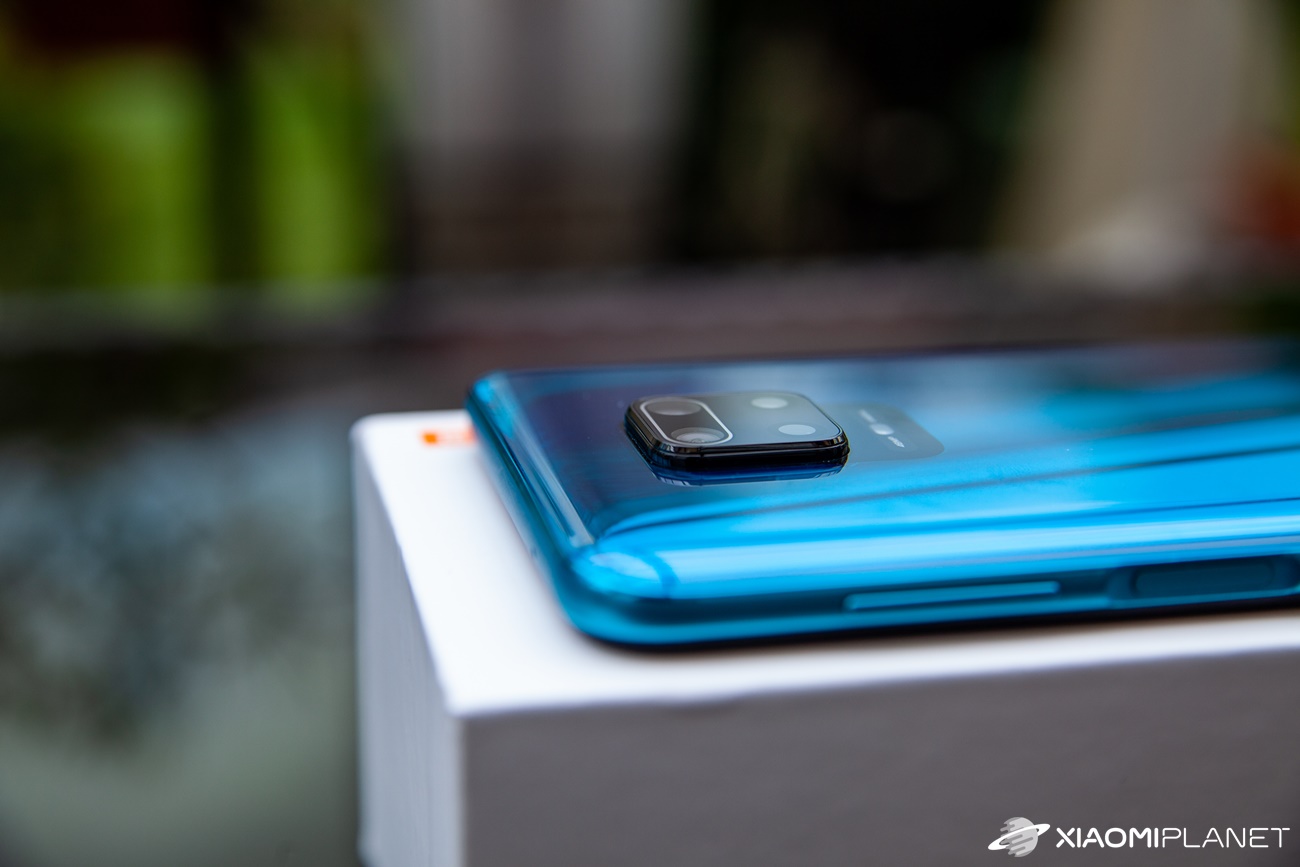
The back cover has a gradient finish, and its color changes depending on the incoming light. It’s an eye-catching design, but it’s also a glossy surface that clearly picks up fingerprints and smudges.

A solution to this issue, as well as to the protruding camera module, is a protective case that’s included directly in the box.
Display: Large IPS panel
A new release from Redmi offers a 6,67” display with IPS technology. It has a Full HD+ resolution (2400 x 1080 pixels), an aspect ratio of 20:9 (395 ppi), and covers almost 85% of the front.
The display is covered by Corning Gorilla Glass 5, with HDR 10 technology included, and it can reach a brightness level of 450 nits.


Following the example of competing IPS panels, this unit also offers very good viewing angles and readability in standard conditions. The display cutout is fairly wide, but it isn’t overly distracting.

However, the colors on this panel felt a bit bland to us—possibly also a little too cold. The good news is that you can correct the color spectrum in the smartphone settings.
What you can’t really adjust is the display brightness. The minimum brightness is fine, and the smartphone could be used without any issues even in complete darkness.
That said, the smartphone deserves a somewhat higher maximum brightness. Readability issues mainly showed up outdoors and in direct sunlight. Auto brightness worked quickly and reliably.
Snapdragon 720G is enough
On the performance side, the smartphone is equipped with an octa-core Qualcomm Snapdragon 720G processor built on a 8nm process. The processor includes cores in a 2 x 2,3 GHz Kryo 465 Gold + 6 x 1,8 GHz Kryo 465 Silver configuration.
The processor is further complemented by the Adreno 618 graphics accelerator. It’s also a very important component that significantly affects the overall user experience. In our hands, the smartphone responded quickly—we didn’t notice any lag, not even during the installation of updates.


This performance package also showed no issues when playing mobile games from the Play Store. In more graphically demanding 3D titles, the gaming experience was also very good. In some games, you had to slightly reduce the level of graphics details.
If you want to compare the performance of this smartphone with yours, AnTuTu tests can help. You can view their results in the photos above.
Storage: 64 GB + memory card
For testing, our editorial office received a version that comes with 4 GB of RAM and 64 GB of internal storage. The internal storage is UFS 2.1, and if needed, a more powerful version is also available on the market, offering a combination of 6 GB RAM + 128 GB internal storage of the same type.
We didn’t run into any issues with RAM performance. This is mainly thanks to the efficient app management of the MIUI software overlay. It monitors and, if necessary, closes background apps so they don’t affect smooth smartphone usage.


After the first startup, Android requires roughly 15,5 GB of free space. After installing dozens of apps and taking about 50 photos, we still had a bit more than 40 GB of free storage left.
For a simpler user, the version with 64 GB of storage is more than enough. Plus, there’s also a microSDXC card slot, so you can expand the storage. But if you think even that isn’t enough, a double-capacity version with 128 GB is also available.
Fingerprint reader: On the side edge
We mentioned unusually arranged device elements. The fingerprint reader falls right into this category. It’s located on the right side edge and is integrated into the button used to turn the device on or off.
The fingerprint reader setup is fairly quick. Its elongated shape compensates for the smaller width compared to other readers, and the matte finish is handled really well. The placement is suitable, and you shouldn’t run into any issues even with smaller hands.
The fingerprint sensor responded very quickly—comparable to standard reader models from previous smartphone generations. The only problem appeared with increased moisture or oily fingerprints; in that case, you had to repeat the attempt.
One way to improve this situation is to re-enroll the same fingerprint repeatedly via the smartphone’s settings. Recognition was noticeably more reliable and faster. Considering the device’s price, there’s really nothing to complain about—it’s a solid, fast sensor.
Android 10 + MIUI 11
The smartphone comes with preinstalled software in the form of Android 10. During testing, we even received a security update. So the phone is fully equipped and includes a May security package directly from Google.


The system is up to date, and with Xiaomi’s cooperation you get full-fledged support—which is genuinely impressive for the smartphone’s price.
There’s also a feature called Digital Wellbeing. It monitors your smartphone usage, creates statistics, and lets you set usage rules for individual functions or apps.


Besides the operating system, there’s traditionally also Xiaomi’s powerful graphical overlay, specifically in the version labeled MIUI Global 11.0.8.0 Stable version.


You don’t miss features like Dark mode, a new font, ringtone sounds, and the manufacturer also guarantees an update to the upcoming, already mentioned MIUI 12 version, which will bring further improvements.
Camera performance is surprising
The smartphone’s photo capabilities are important even in this price range. The main 26 mm sensor in this case offers a resolution of 48 MPx (f/1.8), which the manufacturer also highlights on the back of the device.

The main camera is then complemented by a 8 MPx (f/2.2) ultra-wide sensor that can capture up to 119 degrees of footage. There’s also a 5 MPx macro sensor (f/2.4) and a 2 MPx depth sensor (f/2.4), whose main job is to blur the background.


There’s no shortage of features like an LED flash for brightening scenes, HDR, or panorama. Night mode is part of the well-known Xiaomi Camera app. And this time, night mode didn’t disappoint—it helps especially when lighting is worse.
Original photos in full resolution are available in the link below.
Given the smartphone’s price, the photo quality was very good. In daylight, the camera delivered true-to-life colors (if you watch photos on your smartphone display, we recommend adjusting the color rendering in the phone’s settings), good depth of field, but the only letdown was the doubled zoom.


Surprisingly usable were also the photos from the ultra-wide camera. In this price category, it’s not common to look at good wide-angle photos.
You can record up to 4K (30 fps) video. The front camera sits in a modern cutout in the display, and its resolution is 16 MPx (f/2.5). Its results were also very satisfying even without edits.
Connectivity: Missing NFC
On the connectivity side, fans of standard wired headphones will be especially happy. The phone still offers a 3,5 mm audio jack plus a built-in FM radio. Another plus is a USB Type-C port with USB OTG support and fast charging.

Connectivity is handled via dual-band Wi-Fi 802.11 a/b/g/n/ac, using Wi-Fi Direct technology, with the option to set up a hotspot. You’ll also like the Bluetooth 5.0 LE with A2DP support. An NFC chip is missing for contactless payments.
There’s also GPS technology: A-GPS, Glonass, Galileo, and BDS. A handy and practical feature is the aforementioned infrared port, which can be used to control home electronics, for example. The media sensors included in the smartphone include a compass, accelerometer, gyroscope, and proximity sensor.
Battery: a large 5020 mAh battery pack
The smartphone has a truly above-average battery with a capacity of 5020 mAh. In addition to the high capacity, it also supports fast charging up to 18W, which is really great news in this price category.
On the power consumption side, MIUI is a very power-efficient add-on. With typical use, we had no trouble achieving 2 days of battery life on a single charge, or even comfortably more than 7 hours of an always-on screen.


In our case, typical use included active social media use, hour-long Full HD video playback, hour-long document typing, hour-long calls, and occasional gaming.
With its high-capacity battery, charging is also relatively fast. In 100% thanks to the fast charger it charges in about 90 minutes.
Final verdict: a high-quality smartphone at a great price
The Redmi Note 9S in its price category offers a truly excellent set of features and a high-capacity battery. If you’re looking for a smartphone under €200, this is a very solid alternative.
We bought the Redmi Note 9S here
⚡ Use promo code: GBREDMIN9S123
You’ll enjoy the included accessories and good photo performance—in return, the lack of an NFC chip means you can’t make payments with your phone, for example via Google Pay.
Don’t miss the best coupons 📩
Subscribe and we’ll email you new coupons before they expire. We only send it once a month — no spam.