
The Xiaomi Mi Note 10 smartphone never stops surprising. It achieved excellent results in the DxOmark camera test, and in addition it also has an extra large battery with powerful charging.
How did the developers manage to fit this above-average spec into a nice design?
Xiaomi disassembled the Mi Note 10
The manufacturer published a great video and photos showing the teardown of the Xiaomi Mi Note 10 smartphone. It highlights the individual hardware elements and how they’re arranged inside the phone’s body. It’s almost unbelievable to watch how everything fits neatly together.
At the same time, it’s hard to imagine how much effort the developers put into creating such a design-wise neat, top-class unit with above-average specs.
The disassembly in photos and video shows an apparently simple design that allowed all the necessary components to fit in there. As for the penta camera sensors, the battery, and the speaker, it turns out that good isn’t always little—and their sizes aren’t exactly the smallest.
It all starts with removing the rear glass cover. Then comes several layers of components, including a NFC module, a graphite foil for heat dissipation from the chipset, and the penta camera cover. Inside it are two dual LED flash modules, as well as a laser AutoFocus system and an ambient light sensor to adjust the camera’s color temperature.
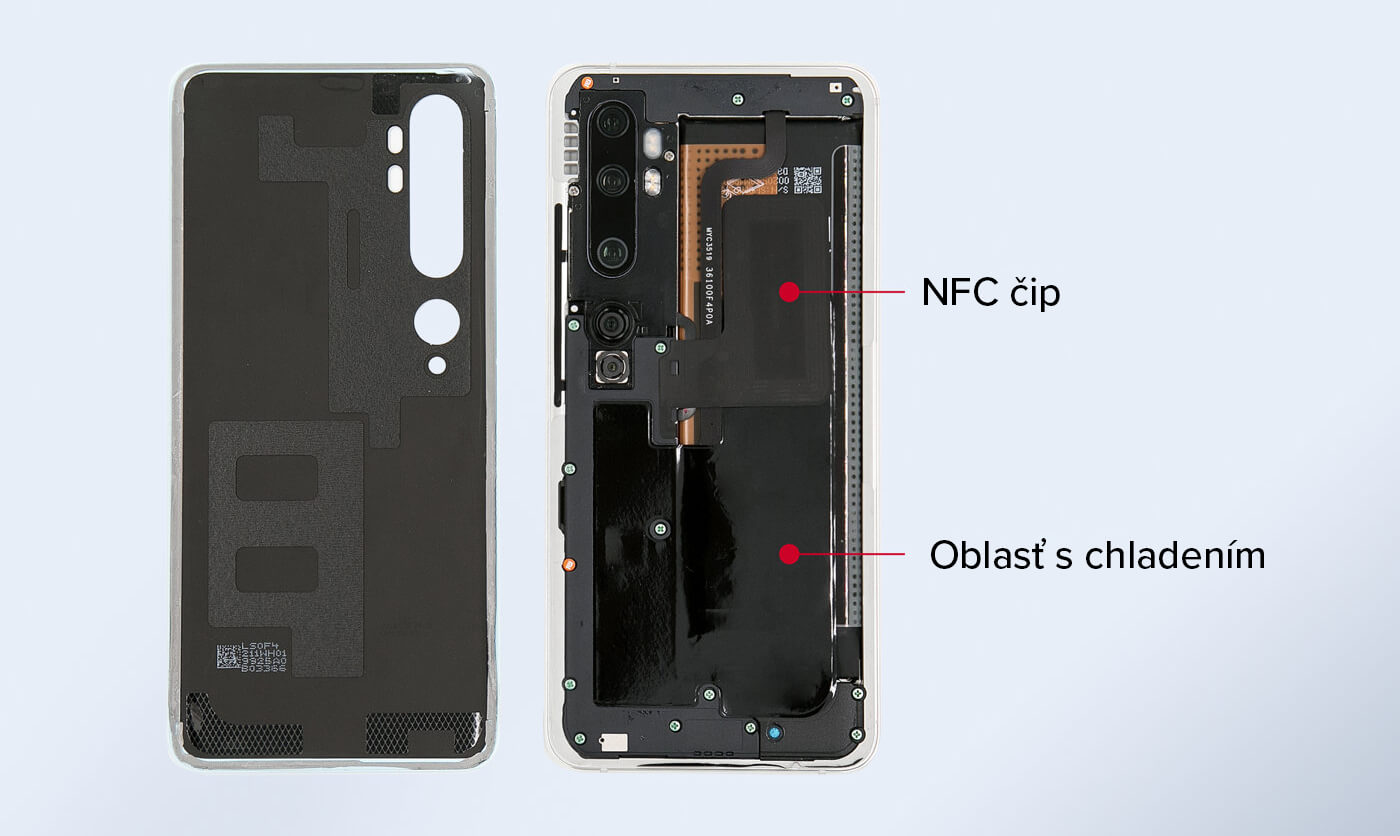
The penta camera module makes up a significant part of the smartphone’s internal space. Dominating it is the huge 108 MPx Samsung sensor. Together with the telephoto lens with 5x zoom, it includes 4-axis optical image stabilization.

What’s interesting is that Xiaomi managed to squeeze an oversized 5 260 mAh battery in between the other components without using an L-shaped battery like Apple, for example. Take note of the 1 CC large speaker chamber under the battery and the 3.5 mm headphone jack.

All this hardware leaves no room for the traditional fingerprint optical reader placed under the display. The manufacturer used an ultra-thin reader, which is only 0.3 mm thick, and its functionality is enabled by a micro-lens with micro-camouflage.
The last interesting element is the main board, which looks rather inconspicuous. The processor Snapdragon 730G shares the board with LPDDR4X RAM and UFS 2.1 storage. There are also various support chips, including hardware for fast 30 watt charging.
More interesting news from the world of Xiaomi—also via email. ?
Don’t miss the best coupons 📩
Subscribe and we’ll email you new coupons before they expire. We only send it once a month — no spam.