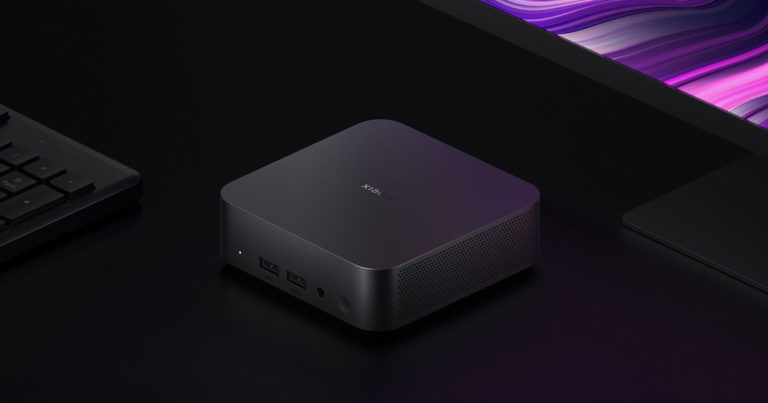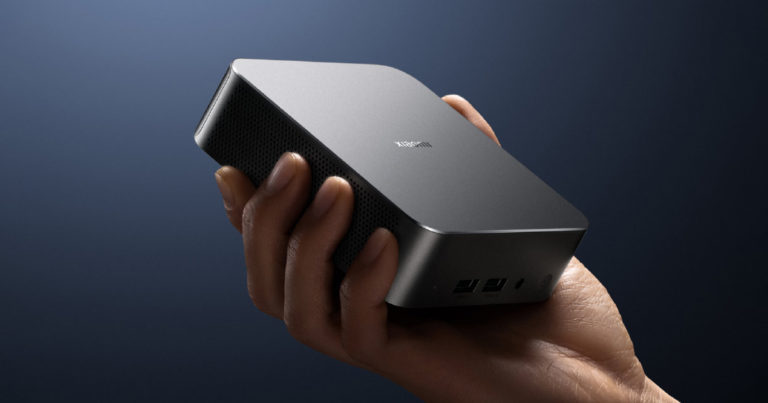

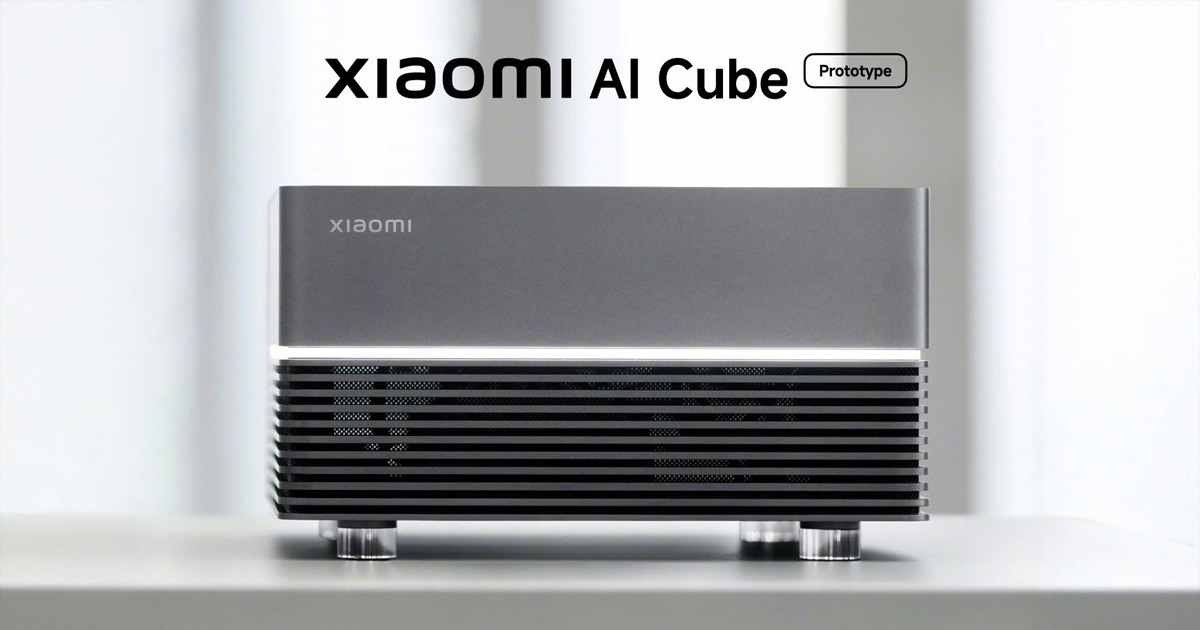
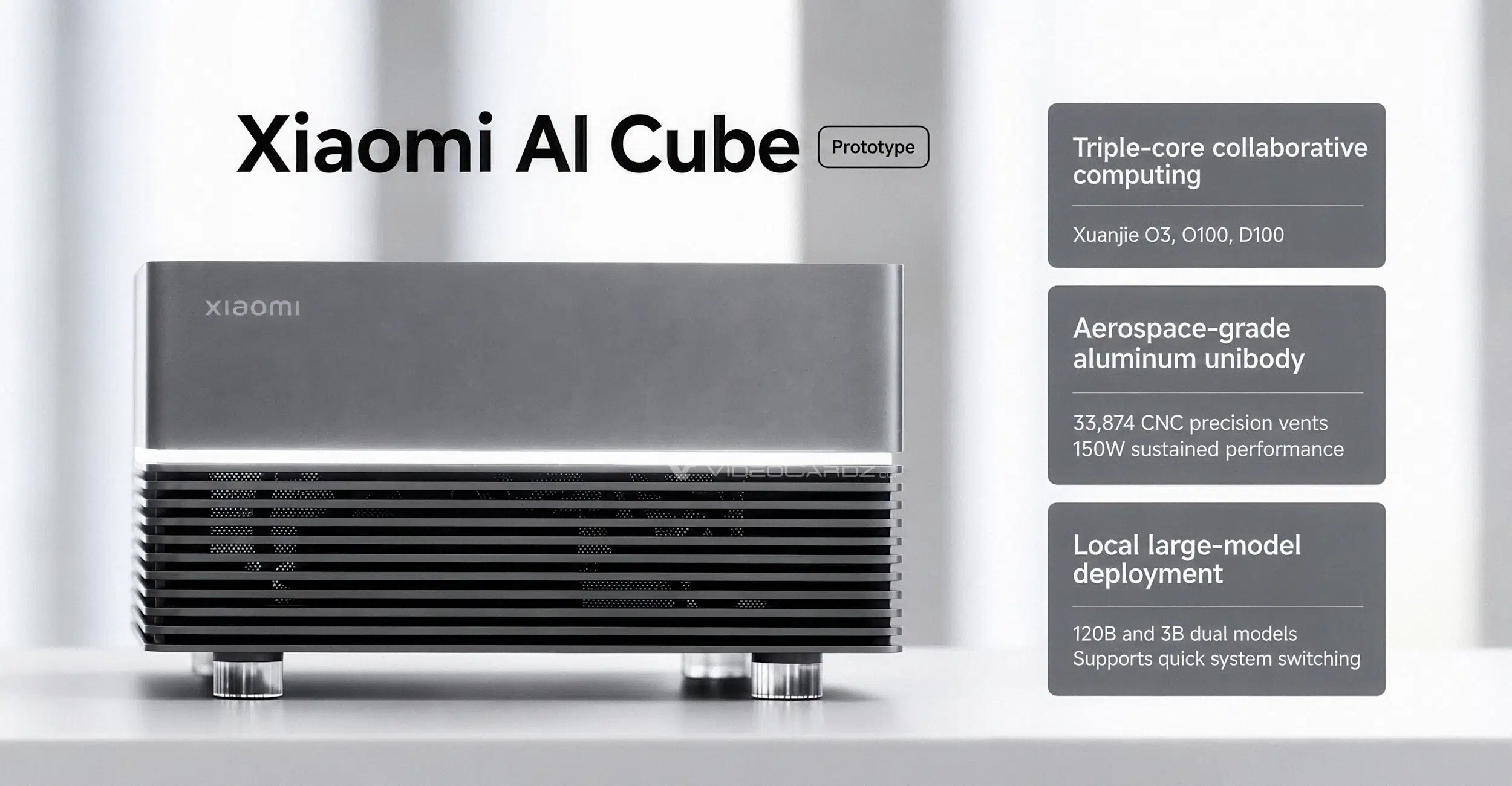
- At the XRING conference, Xiaomi showed a prototype mini-computer AI Cube that combines three of its own custom chips.
- Inside are the XRING O3, O100 and D100 — a mobile SoC, a memory accelerator and a 3nm chip originally intended for autonomous driving.
- The cube can keep both a 120-billion-parameter model and a small 3B model in memory at the same time and switch between them.
- Continuous power draw is up to 150 W, and the body is made from an aluminum unibody with 33 874 CNC-milled holes.
- It’s still just a prototype — there’s no price or launch date, and the O100 and D100 chips won’t enter mass production until 2027.
Xiaomi has had a busy week. A day after introducing the XRING O3 mobile chip, it took the stage with something no one expected — a discreet aluminum cube that looks more like a hi-fi amplifier than a computer. It’s called the Xiaomi AI Cube, and its only job is to run a large language model right at your home, without a cloud connection and without a single foreign chip inside.
Three custom chips in one cube
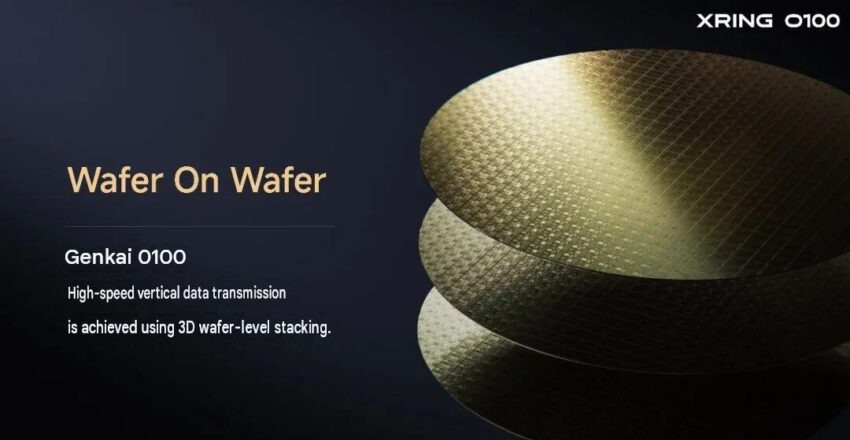
The core of the AI Cube isn’t the box, but what Xiaomi packed into it. It uses three different chips from the XRING family, each from a completely different category: a mobile SoC, a memory accelerator, and a processor originally meant to control a car. The company made them work together on one job only — running large models locally.
The main brain is the XRING O3 — the same chip that, a day earlier, pushed AnTuTu past five million points. It has a ten-core CPU made exclusively of big cores, a sixteen-core G2-Ultra NX GPU, and an NPU with 200 TOPS of performance. We’ll soon see it in phones in the foldable Xiaomi 18 Fold, but here it acts as the general commanding the whole setup.
XRING O100: memory stacked directly on top of compute
The most interesting piece of silicon in the cube is the XRING O100, an accelerator built on a 6nm process. For it, Xiaomi used 3D Wafer-on-Wafer stacking — it layered two DRAM memory dies on top of the logic layer with the NPU and connected them using hybrid bonding with a contact pitch of just 1.4 micrometers.
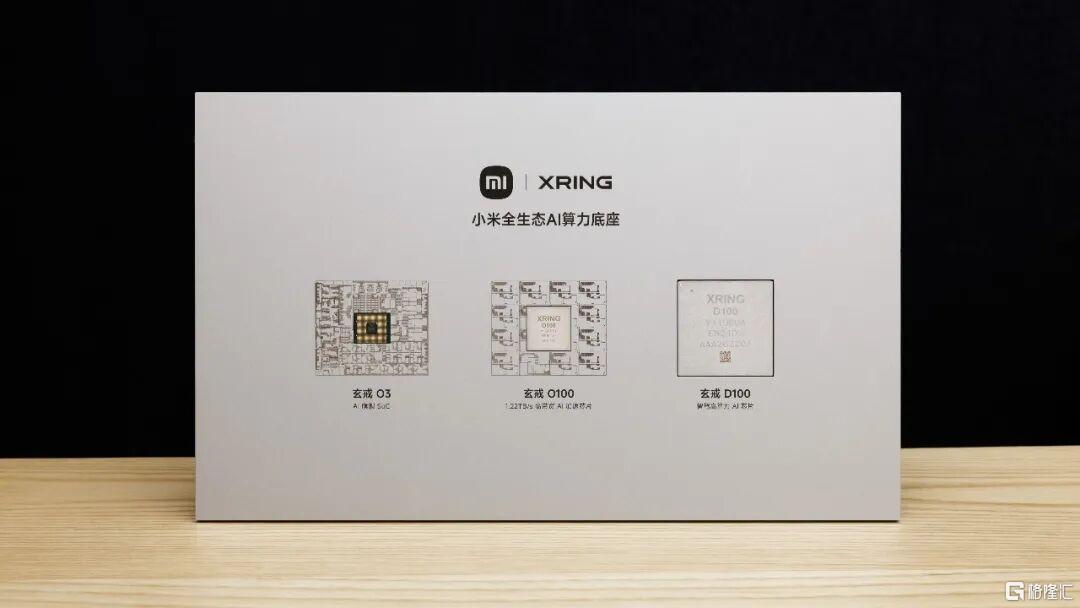
That sounds like a detail for manufacturing engineers, but the result is very practical: data travels only a tiny fraction of the original distance from memory to the compute unit. Xiaomi says there are 28,672 effective data links and 1.22 TB/s of bandwidth. For large language models, data transfer from memory is what slows them down the most — not the actual computation.
XRING D100 came from a car and brought 160 GB of memory
The third chip is the XRING D100, built on a 3nm process. It was originally designed for intelligent vehicle control, which makes sense — Xiaomi now makes cars too and needs its own compute hardware in them. It combines a twenty-core CPU with a sixteen-core NPU and, above all, supports up to 160 GB of shared memory.
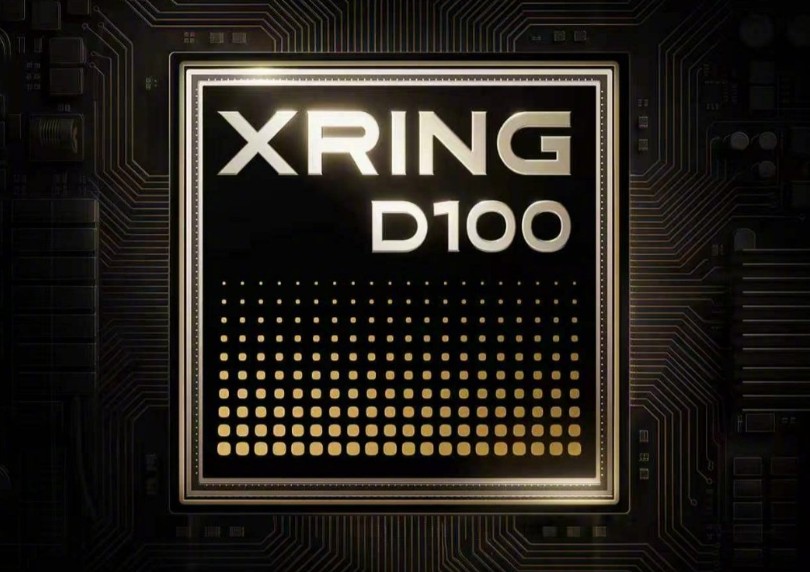
And that memory is the most important number in local AI — it determines how big a model can actually fit into your computer. Xiaomi says the D100 alone can handle a model with up to 200 billion parameters. For comparison, NVIDIA’s home AI computer DGX Spark offers 128 GB of shared memory for just under $4,700. So the Chinese manufacturer is targeting exactly the category NVIDIA has almost had to itself until now.
What does the average user get out of it?
The example Xiaomi demonstrated was specific: the AI Cube simultaneously keeps in memory a model with 120 billion parameters and a small model with 3 billion, and can switch between them depending on what you need from it right now. The small model answers immediately to simple questions, while the large one turns on when you really need to think — in Xiaomi terminology, it’s switching between the “fast” and the “slow” system.
It all runs at a continuous power draw of up to 150 W, which is roughly the consumption of a desktop PC with a weaker gaming GPU. Cooling is handled by an aluminum unibody milled as a single piece, into which Xiaomi carved 33,874 precise holes — that’s where the hi-fi component look comes from. The practical benefit is clear: conversations, documents, or voice commands don’t leave your home.
When and for how much? Not yet
Here comes the cold shower. AI Cube is an engineering prototype, not a product. Xiaomi hasn’t given its price, release date, or even whether it will ever reach retail. Company head Lei Jun confirmed on Weibo that all three chips have been designed and verified, but O100 and D100 will go into mass production only next year, i.e. in 2027. The only one that will reach people earlier is O3 in Xiaomi 18 Fold.
The VideoCardz noticed a small discrepancy in the presentation as well: while Xiaomi says D100 should handle models with 200 billion parameters, the AI Cube demo itself ran on a pair of 120B and 3B. It’s therefore unclear whether this is a hardware limit in that specific setup, or just a conservative choice for the demo. The answer will come no sooner than 2027 — along with whether Xiaomi really plans to put the cube in stores.
| - | Xiaomi AI Cube (prototype) |
|---|---|
| Main chip | XRING O3 – 10-core CPU / GPU G2-Ultra NX with 16 cores / NPU 200 TOPS |
| AI accelerator | XRING O100 – 6 nm / 3D Wafer-on-Wafer / 1.22 TB/s |
| Third chip | XRING D100 – 3 nm / 20-core CPU / 16-core NPU |
| Memory | up to 160 GB of shared (XRING D100) |
| Local models | 120B + 3B at once / D100 supports up to 200B |
| Data links in O100 | 28 672 effective |
| Power input | up to 150 W continuous |
| Body | aluminum unibody with 33 874 CNC holes |
| Availability | prototype — no price and no date |
To get more updates from the world of Xiaomi, keep following our Xiaomi Planet website. Join our Facebook group, where we build an active community and help each other out. Subscribe to our Telegram as well, where we add the best deals and coupons from China every day.
Don’t miss the best coupons 📩
Subscribe and we’ll email you new coupons before they expire. We only send it once a month — no spam.