
Verdict: Redmi Note 13 Pro+ 5G
Our editorial rating based on product testing.
- modern, fresh design with a comfortable grip
- first time with an AMOLED display with curved edges
- fast charging, up to 120 W
- IP68 certification
- eSIM support
- worse color rendering of some photos taken in low light (white balance issues)
- older Android version and MIUI’s graphical interface with plenty of bloatware
Redmi Note 13 Pro+ 5G we’ve been using in the editorial office every day for more than 2 weeks so we can bring you a detailed review based on our own experience. It’s one of the most attractive mid-range smartphones and a direct competitor to the recently reviewed POCO X6 Pro 5G.
In our review, you’ll learn about all the specs of the new Redmi smartphone. We’ll also test the 200 MPx camera, battery life, and charging—and last but not least, we’ll take a look at the user interface and performance.
Where to buy Redmi Note 13 Pro+ 5G?
The new Redmi Note 13 Pro+ 5G is now available from our Chinese partners. The best deals and current coupons can be found in the price box below. The smartphone is also available from a European warehouse with express delivery and a 2-year warranty.
Redmi Note 13 Pro+ 5G Global Version
 FR warehouse

TIPFast delivery from the French warehouse with no customs duty or VAT.
This product will be delivered to you quickly from a local Spanish warehouse. Shipping from Spain usually takes 7-10 days and is handled by a courier. When it arrives, you don’t pay any extra fees—no customs duty, no VAT.
Our extra service with VIP support — we’ll handle the order on DHgate for you and ship it straight to your address.
If you don’t have experience buying on DHgate, your payment won’t go through, or the coupon doesn’t work, we offer our readers and customers an order-handling service delivered directly to your address. You send us the money by bank transfer and we order the product straight to you. That way, you don’t have to worry about a failed payment or applying the coupon, and you can be sure the whole order goes through 100 % correctly. On top of that, you automatically get our VIP support — we handle any shipping issues for you and assist with warranty claims. The fee for this service is 15 € for the product price. You can contact us by email at info(@)xiaomiplanet.sk or on Messenger, where we’re active all the time.
Technical specifications
| Model | Redmi Note 13 Pro+ 5G |
|---|---|
| Dimensions | 161.4 x 74.2 x 8.9 mm |
| Weight | 204.5 g |
| Display | 6.67" CrystalRes AMOLED |
| resolution 2712 x 1220 px (446 PPI) | |
| refresh rate 120 hz | |
| contrast ratio 5 000 000:1 | |
| max brightness 1800 nits | |
| Corning Gorilla Glass Victus | |
| Dolby Vision and HDR10+ | |
| Memory RAM | 12 GB LPDDR5 |
| Storage | 512 GB UFS 3.1 |
| Processor | MediaTek Dimensity 7200-Ultra (max 2.8 GHz / 4 nm) |
| Cameras | main 200 MPx | OIS + EIS | aperture f/1.65 |
| ultra-wide 8 MP | aperture f/2.2 | |
| macro 2 MP | aperture f/2.4 | |
| selfie 16 MP | aperture f/2.4 | |
| Battery | 5000 mAh |
| Charging | 120 W |
| Android | 13 |
| Graphics interface | MIUI 14 |
| NFC | yes |
| Bluetooth | 5.3 |
| WiFi | WiFi 6 |
| IP certification | IP68 |
Box without a charger
Redmi Note 13 Pro+ 5G was delivered to us by the SPS courier in standard packaging, just like we’re used to with smartphones from Chinese sellers. The phone’s box arrived wrapped in air protection and a nylon sleeve.

At first glance, the packaging is completely normal. On top, there’s a paper envelope with a SIM slot ejection pin, paper documentation, and a protective case. Under it, you’ll find the smartphone itself in a transparent protective film.

At the bottom of the box, though, we only find a charging cable without a charger, even though there’s space for the adapter. We expected charger-free versions to be better value, but at the time of writing the review, the current prices are actually better for packages that include a charger.

Design and build quality
You can buy the Redmi Note 13 Pro+ 5G in three color variants. Besides the standard black, you can also choose white and—possibly the most interesting—purple, the so-called Aurora Purple.

With this color, Redmi is clearly aiming at the younger generation and it will probably appeal more to women. It’s a special color variant where the Chinese manufacturer combines three colors around the rear camera module. They’re bold and large, protruding from the back cover. Compared to last year’s Redmi Note 12 Pro+, this is a significant change—for the better.

As for build quality, since it’s a mid-range smartphone, don’t expect any premium materials. The phone is made of plastic, but still feels very high-quality—almost premium. At first glance, you wouldn’t guess it’s a smartphone with a price tag only slightly above 300 EUR.

In this case, the design definitely turned out well. Redmi moved from the boring, plain design of last year’s lineup to a fresh, modern, and attractive style. It’s a shame the manufacturer includes a matte black protective case with a large cut-out that absolutely doesn’t match it.
Comfortable grip and standard placement of elements
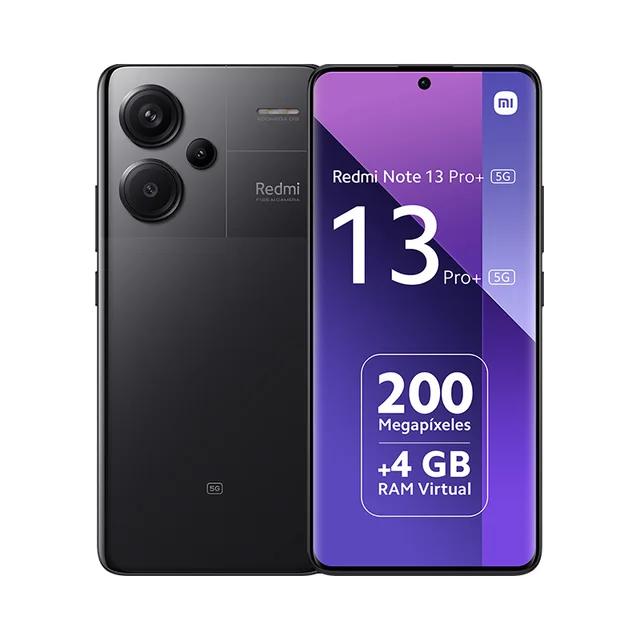
The Redmi brand decided not to follow the trend of sharp edges, and instead keeps rounded edges, which makes the smartphone very comfortable to hold in your hand. However, it’s not a small compact model. It measures 161.4 x 74.2 x 8.9 mm and weighs 204.5 g.

When we look at the placement of the individual elements, there’s no significant change compared to the usual standard. The bottom edge is home to the charging USB-C port, a SIM card slot, a microphone, and a speaker. The opposite, top edge contains the second speaker, a microphone, and sensors.

The left side is traditionally empty, while on the right side you’ll only find the volume control buttons and a power button to turn it off / on or to light up the screen.
A breakthrough model in many ways
The Redmi Note 13 Pro+ 5G is often described as a breakthrough in many ways, thanks to the many new features it brings—things that we’re not used to seeing in smartphones of this category and brand. The first novelty is an AMOLED display with rounded edges on the sides, making it the first Redmi smartphone with such a display.

A curved display is usually a privilege of more expensive models, but that’s no longer the case. Even though curved displays have their detractors due to unwanted glare or accidental touches, we like this kind of display and it definitely gives the smartphone a more premium look.
Here you’re getting a 6.67″ AMOLED display with 1.5K resolution of 2712 x 1220 px. It has a high refresh rate of 120 Hz that can dynamically adapt to your current needs. You’ll also appreciate the extremely high maximum brightness—up to 1800 nits—and 100% coverage of the DCI-P3 color profile.

The display is protected by the latest Corning Gorilla Glass Victus protective glass, has 16 000 levels of brightness, and supports technologies like HDR10+ and Dolby Vision.
The rounded edges aren’t the only novelty, though. The Redmi Note 13 Pro+ 5G is also the brand’s first smartphone to feature an in-display fingerprint reader. It works very well and reliably.

Despite the AMOLED display, you only get a 10-second always-on display out of the box. However, we already know how to get around this limitation—just as we mentioned in the review of the POCO X6 Pro 5G. Simply go to the developer settings and turn off the MIUI optimization there.


This change also brings certain drawbacks. The visibility of the digits in the battery icon with the percentage status will be worse, since the numbers are shown in the same color as the background. The fix is to switch the percentage status display in the settings to show it next to the battery icon, not inside it.
The second, also cosmetic, issue is the square icons of some system apps, while the other app icons have rounded shapes.
With a MediaTek processor
Lately, more and more Chinese brands have been turning to MediaTek processors. The Redmi Note 13 Pro+ 5G is one of them as well, and it comes with a MediaTek Dimensity 7200-Ultra. It’s a 8-core processor from September 2023, built using a 4 nm technology.

It consists of two Cortex-A715 cores running at 2800 Mhz and six Cortex-A510 cores with a clock speed of 2000 Mhz. Compared to the competition—specifically the POCO X6 Pro 5G—based on benchmarks, it’s clearly weaker, but in everyday use it’s completely trouble-free. Performance is more than enough, and the processor is well suited to the smartphone class that the Redmi Note 13+ Pro 5G belongs to.

As for memory, our tested Redmi uses 12 GB of LPDDR5 RAM and 512 GB of UFS 3.1 storage. It’s not quite the newest and fastest memory, but in this case it’s definitely nothing outdated. Read and write speeds are still high. You also get a RAM expansion feature that adds another 6 GB from internal storage, bringing you up to 18 GB of RAM.
The 12 / 512 GB memory version is the top one. You can also buy a lower memory option—specifically 8 / 256 GB.
Effective cooling has also been taken care of: the smartphone has a 4 000 mm2 area for the cooler itself, the so-called Vapor Chamber, and up to 11 000 mm2 of passive graphite material inside the phone, which also helps dissipate heat.
An up to 200 MPx main camera. A marketing gimmick?
The Redmi Note 13 Pro+ 5G can boast a main camera with a resolution of up to 200 MPx. Whether this camera is really as good as its megapixel count suggests—we’ll take a look at that in this chapter. But first, let’s go over the known specifications of all the cameras:
| Main 200 MPx | 1/1.4" Samsung ISOCELL HP3 sensor | f/1.65 aperture | OIS + EIS |
|---|---|---|---|
Ultra-wide 8 MPx | 1/2.8" Sony IMX355 sensor | f/2.2 aperture | - |
Macro 2 MPx | 1/5" Omnivision OV sensor02B10 | f/2.4 aperture | - |
Note: information about specific sensor models is not from Xiaomi’s official website

The dominant camera is clearly the main one with 200 MP resolution, which also has optical image stabilization and provides 4-times optical, lossless zoom during shooting. The photos taken with it are mostly sharp and full of detail, but we have to admit it has better marketing than results.


High resolution up to 200 MP is a bit unnecessary and is more of a marketing lure for the average consumer, who gets drawn in by a high megapixel count. In good lighting conditions during the day, you can take great photos with it, but problems start in worse lighting.


Even with a cloudy sky, we can often spot strange colors with a slight purple tint, and at other times a green one. Indoors with artificial lighting, it’s similar. White balance is clearly causing issues for this smartphone. For comparison of color rendering, we’re including photos from all three cameras:


Ultra-wide camera, zoom, and macro
The photo setup of the new Redmi Note 13 Pro+ 5G also includes an ultra-wide camera, but it has far fewer megapixels—specifically 8. Even at first glance, the wide shots are darker, have worse dynamic range, weaker sharpness, and overall, of course, it’s a worse camera.


As for color rendering, in this case it’s cooler and the photos have higher contrast. Still, you can take nice shots with it, but mostly in good lighting conditions—during a sunny afternoon or in a well-lit interior.

Redmi states that the new smartphone from the Note 13 series can deliver up to 4-times optical zoom without losing quality. However, we don’t have a full-fledged telephoto camera here—the smartphone performs the zoom by cropping from the 200 MP main camera.
Doubly zoomed photos are quite good—they have similar characteristics to those taken without zoom and offer enough detail. But at 4-times zoom, we wouldn’t say it’s lossless zoom anymore.


The photos have a different color rendering now—they’re clearly less sharp and therefore less detailed. Let’s also mention the macro camera, which is completely unnecessary, because prettier shots can be made by cropping the zoomed-in part from a photo taken with the main camera. The macro has only 2 MP, fixed focus, so it’s fairly hard to shoot with. The output is also very weak.


Night photos
The main camera makes the best night photos, which is no surprise. Night shots from the main 200 Mpx camera are quite sharp, and we also like its colorful rendering. The same goes for the 2x zoom.


The ultra-wide camera didn’t impress us as much. It often produces visibly blurred shots, even with pretty good street lighting. The 4x zoom after dark is almost unusable. Here, sharpness is very weak and the photos look like from a cheap phone from a few years ago. This definitely isn’t lossless zoom.


Video in 4K
The maximum video resolution is 4K at 30 fps. This resolution is stabilized too, but not very well. In the video, you can see a lot of shake and small smearing that most likely comes from the stabilization. Next, you can choose between 1080p at 30 or 60 fps, and also 720p at 30 fps. In the settings, you can also enable better stabilization, which will however reduce the resolution to 1080p/30 fps.
You can watch a short demo of the 4K video on our YouTube:
Battery and charging
Redmi Note 13 Pro+ 5G has a standard 5000 mAh battery, but it supports up to 120 W charging. Since there hasn’t been any progress in batteries for a long time, at least fast charging will please you. It may not charge in the 19 minutes claimed by the manufacturer, but it’s still extremely fast charging.

You can see the entire charging process from 20 % to 100 % in the table below:
| capacity | time |
|---|---|
| 20 – 50 % | 6 minutes and 10 seconds |
| 75 % | 12 minutes and 33 seconds |
| 90 % | 17 minutes and 35 seconds |
| 100 % | 24 minutes and 30 seconds |
When it comes to battery life on a single charge, based on the standard battery, don’t expect any surprises. The smartphone typically lasts one day, depending on how you use it.
Still with MIUI 14 and Android 13
At a time when Xiaomi smartphones are already getting updates to the latest Android 14 along with the new HyperOS system, the recently unveiled Redmi Note 13 Pro+ 5G is still only coming with Android 13 and MIUI 14. The Chinese giant explains this move by saying that, during the development of HyperOS, the system wasn’t yet polished enough for them to use.

Since it’s a new release, we’d expect at least that the manufacturer would rush the HyperOS update and bring it to stores shortly after the smartphones from the Redmi Note 13 series go on sale. Unfortunately, that hasn’t happened and we haven’t received the update yet.

Unfortunately, we don’t see MIUI 14 in this smartphone as entirely positive. The system is cluttered with a lot of different apps, games, and links to download more games. There’s even a kind of built-in App Mall that’s used to download various apps. Since most of us install apps via the official Google Play Store, we see this extra app store as unnecessary. You can’t uninstall it.

There are also annoying ads that come in as notifications from Mi Browser or various suggestions with tips—for example, about themes. Luckily, we can simply disable these push notifications in the app’s settings.


On the other hand, when it comes to the functionality of MIUI, we have no complaints. Besides unnecessary bloatware and unwanted notifications, we’re happy with the interface. It offers plenty of settings, has a modern design, and works flawlessly.
Sound and connectivity
The Redmi Note 13 Pro+ 5G has a pair of speakers, but they’re not particularly high-quality. Instead, they’re more on the average side—so don’t expect a great music experience.

Wireless connectivity also includes NFC for mobile payments; Bluetooth is now version 5.3 or WiFi with version 6. The smartphone supports 5G networks and eSIM as well. Instead of activating one of the two SIM cards, you can activate an eSIM card with your operator.
Redmi Note 13 Pro+ 5G: Final verdict
The Redmi Note 13 Pro+ 5G is one of the most eagerly anticipated mid-range smartphones. Compared to last year’s model, it brings a noticeable improvement to the design, which this time is especially successful—fresh, and modern. Besides design changes, there are also two very interesting new features here. For the first time in the history of the Redmi brand, a curved AMOLED display and an in-display fingerprint sensor have been used.

The Redmi Note 13 Pro+ 5G looks more premium, but despite several new features it didn’t bring the latest operating system, Xiaomi HyperOS. Once again, you only get Android 13 and MIUI 14, and the HyperOS update isn’t available yet.
The smartphone has enough performance, runs smoothly, has fast memory, supports eSIM, has an IP68 certification, 120 W charging, and an attractive price tag. However, it also has some minor downsides—mainly related to the cameras. The main camera sometimes has trouble with white balance and, despite the 200 MP resolution, it doesn’t deliver anything truly exceptional. The ultra-wide camera has only 8 MP, and the manufacturer could’ve skipped the unnecessary 2 MP macro.
Don’t miss the best coupons 📩
Subscribe and we’ll email you new coupons before they expire. We only send it once a month — no spam.