

We already know the Xiaomi Mi 9 Lite and Redmi Note 8 Pro smartphones, and they’ve been on the market for some time now. Both models have been compared on our site with several other phones, but they haven’t faced each other directly yet.
Big competitors
However, these two mid-range models have now moved closer to each other in terms of price too—and that’s where the big decision comes in before you buy. We’re increasingly seeing user questions that are exactly about these two smartphones and the dilemma of which one to choose.
We decided to lend a helping hand and prepared a spec comparison of both smartphones. First, the basic information in a table.

| Xiaomi Mi 9 Lite | Redmi Note 8 Pro | |
|---|---|---|
| Dimensions | 156.8 x 74.5 x 8.7 mm | 161.3 x 76.4 x 8.8 mm |
| Weight | 179 g | 199 |
| Used material | Glass-Aluminum | Glass-Plastic |
| Display | AMOLED / 6.39 inches | LTPS LCD / 6.53 inches |
| 1080 x 2340 px | 1080 x 2340 px | |
| 403 ppi density | 395 ppi density | |
| Gorilla Glass 5 | Gorilla Glass 5 | |
| In-display fingerprint sensor 7. gen. | Fingerprint sensor at the back | |
| LED notifications | Yes | Yes |
| Processor | Snapdragon 710 | MediaTek Helio G90T |
| Graphics | Adreno 640 | Mali-G76MC4 |
| Measured performance in AnTuTu | 174 000 | 282 000 |
| 4G LTE band support B20 | Yes | Yes |
| Primary camera | 48 MPx Sony IMX586 Exmor RS | 64 MPx Samsung Bright GW1 |
| CMOS | ISOCELL | |
| aperture f/1.79 | sensor size 1/2″ | 0.8 µm | Aperture f/1.9 | Sensor size 1/1.7″ | 0.8 µm | |
| Laser/PDAF autofocus | Laser/PDAF autofocus | |
| 4K 30 fps video | 4K 30 fps video | |
| Secondary cameras | 8 MPx ultra-wide | f/2.2 aperture | 1.12 µm | 8 MPx ultra-wide | f/2.2 aperture | 1.12 µm |
| 2 MPx depth sensor | f/2.4 aperture | 1.75 µm | 2 MPx depth sensor | f/2.4 aperture | 1.75 µm | |
| - | 2 MPx macro | f/2.4 aperture | 1.75 µm | |
| Front camera | 32 MPx | 20 MPx |
| Aperture f/2.0 | 0.8 µm | Aperture f/2.0 | 0.9 µm | |
| SD Card | Yes – hybrid slot | Yes – hybrid slot |
| 3.5 mm jack | Yes | Yes |
| Infraport | Yes | Yes |
| NFC | Yes | Yes |
| Radio | Yes | Yes |
| Battery | Li-Pol 4030 mAh | Li-Pol 4500 mAh |
| Fast charging 18 W | Fast charging 18 W | |
| Wireless charging – NO | Wireless charging – NO | |
| Enhanced durability | - | IP52 |
Design
The look of both smartphones feels like it’s straight out of the flagship segment, not the mid-range. Both are top-notch in terms of build quality, and the displays are set in modern, thin bezels. Both devices come in three different color combinations with modern shades.


The difference in dimensions is only minor, especially in height—on the larger Redmi Note 8 Pro it’s 4.5 mm taller. The biggest difference in this category is weight. Xiaomi Mi 9 Lite is lighter by a full 20 g, which is quite a lot. This smartphone therefore feels more compact and is more comfortable to carry, making it the winner in this category.
Display
Bigger is usually better, but that doesn’t always hold true. The displays of both smartphones have almost identical specs. The Mi 9 Lite display is 0,14 inches smaller diagonally. However, they have the same resolution, and the Note 8 Pro has a slightly smaller pixel density per square inch due to its size.

Both displays lose a small portion of the surface area due to the notch for the front camera. But the major difference is the technology used. Mi 9 Lite comes with an AMOLED panel, while the Note 8 Pro uses only a standard LTPS display. The Mi 9 Lite wins here too, delivering more vivid and realistic colors with higher brightness and high contrast.
Plus, thanks to AMOLED, the display also includes the fingerprint sensor, which is truly fast. Some users prefer the sensor on the back, so we won’t treat that as a clear plus or minus.
Power
In this area, we won’t speculate or argue. The gaming chipset Helio G90T from MediaTek clearly comes out on top over the Snapdragon 710. Just look at the individual scores from the AnTuTu performance test.

Both smartphones come in versions with at least 6 GB RAM and 64 GB storage. That can be expanded with a memory card at the expense of one SIM card. The Redmi Note 8 Pro also has liquid-based cooling, which significantly reduces the hardware temperature during demanding computing tasks. That helps maintain software stability and reduces power consumption.

Redmi Note 8 Pro is clearly leading, especially in graphics performance, and its Mali-G76MC4 graphics chip is slightly more powerful than the Adreno 640 in the Mi 9 Lite. That means you can play games like PUBG or Fortnite on the Note 8 Pro without any issues.
When it comes to performance, the clear winner is Redmi Note 8 Pro. However, both smartphones are perfectly smooth, and both can handle demanding games too.
Cameras
If we imagined a set of balance scales, this category would be like comparing phones on a seesaw. One has the better feature, the other has that one. We won’t go into a scientific analysis of the primary sensors of each model.
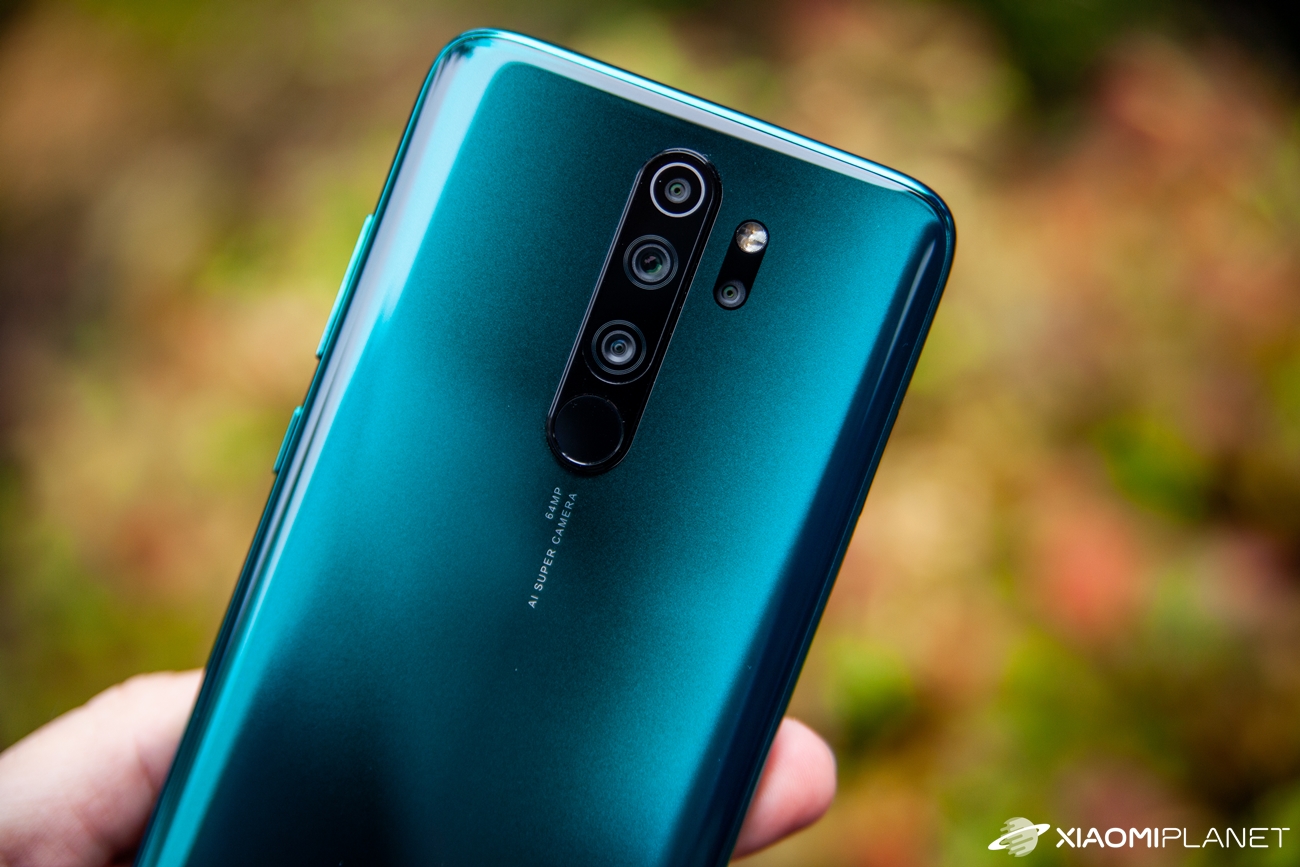
CMOS and ISOCELL sensor types split fans into two camps. Redmi Note 8 Pro introduced a large 64 MPx Samsung sensor and pairs it with a combination of three additional cameras. Mi 9 Lite has a slightly smaller Sony sensor with 48 MPx resolution, but we’d dare to say that with it you can capture even higher-quality photos.
As they say, megapixels aren’t everything, and in this case that’s true. Mi 9 Lite produces sharper photos in some conditions than Note 8 Pro. The camera in Mi 9 Lite also has the upper hand when it comes to dynamic range and contrast. Below, you can check out the photo comparisons.


In the camera section, we lean toward Mi 9 Lite, which processes nicer photos.
Battery
If we look at the specifications of both models, the winner is immediately clear. Redmi Note 8 Pro has a battery with a capacity of 4,500 mAh, while the smaller Mi 9 Lite has a 4,030 mAh battery. The question, however, is whether battery life per charge won’t end up being similar under real-world conditions.

Note 8 Pro has a larger display and a more power-hungry processor, which could ultimately also show in power consumption. Both rivals support 18 W fast charging. In this category, we dare to call it a tie.
Price
Regardless of everything, price is one of the most decisive factors. So let’s look at the price range these smartphones fall into. We picked the cheapest but verified source where we can get both models, and that is of course the Deal Planet website.
Xiaomi Mi 9 Lite in the version with 6 GB RAM and 128 GB storage currently costs 210 € / 5124 kč -> GET THE DISCOUNT
(price changed on 25.12., previously 199 €)
Redmi Note 8 Pro in the same version with 6 GB RAM and 128 GB storage currently costs 187 € / 5033 kč -> GET THE DISCOUNT
So which one is better?
Choosing a winner from this pair is anything but easy. Redmi Note 8 Pro clearly has the edge in gaming performance, and if you like playing games, this model is definitely for you. Another advantage of this model is increased resistance to water and dust thanks to the IP52 certification. It is also slightly cheaper.

On the other hand, if you want high-quality photos and a gorgeous AMOLED display, go for Mi 9 Lite. No matter which of the models you choose, you definitely won’t be disappointed.
We also send Xiaomi product comparisons by email. ?
Don’t miss the best coupons 📩
Subscribe and we’ll email you new coupons before they expire. We only send it once a month — no spam.