
Verdict: Redmi Note 8
Our editorial rating based on product testing.
- High-quality build
- Decent 48 MPx camera
- 4000 mAh battery with long-lasting battery life
- Fast system
- Special speaker feature - self-cleaning
- Low price
- No NFC (available Redmi Note 8T model with NFC)
- Thicker bezels around the display
Redmi, Xiaomi’s daughter brand, focuses mainly on devices with an excellent price/performance ratio. After separating from the parent Xiaomi, the brand started producing a range of products and new smartphone models.
Only half a year after launching the seventh-generation Redmi Note smartphone, they introduced the next, eighth generation. Redmi Note 8 has been on the market for some time now, and it has finally made it to us for a detailed review. So what exactly is Redmi Note 8?
Where to buy it for the best price
We got the Redmi Note 8 from the Gearbest webshop, which offers discount coupons on the smartphone. During the sale, all memory versions are available—32, 64, and 128 GB models.
Best coupons from Gearbest 
I want a discount on the Redmi Note 8
Thanks to EU Priority Line shipping, we didn’t pay any extra fees upon delivery, and the delivery took just 15 days.
A standard box, again with accessories
The Redmi Note 8 smartphone arrives in a standard box featuring an image of the device, which also includes extra accessories. Right on top of the packaging there’s a paper envelope containing manuals, a simple silicone case for protecting the phone, as well as a pin to eject the SIM card and a memory card.
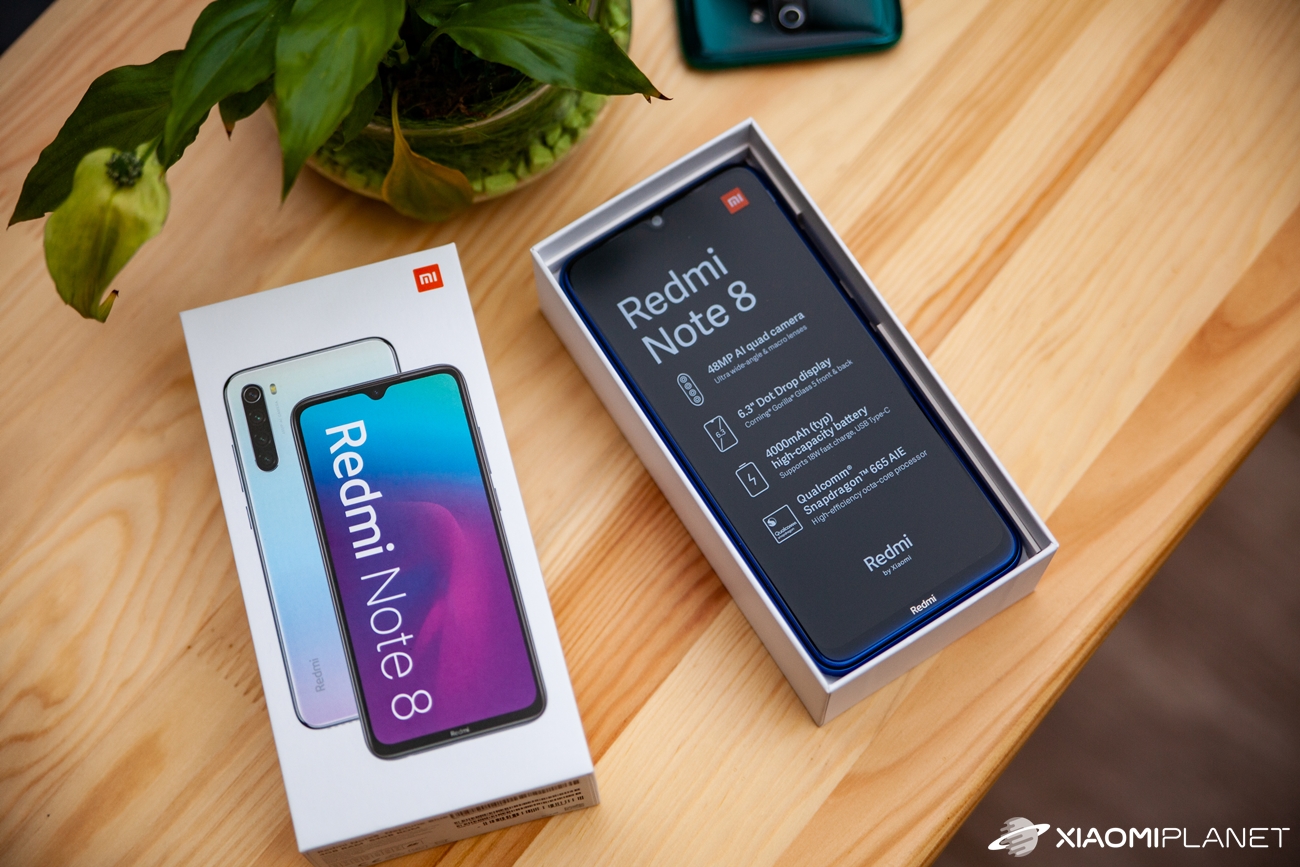
Below that you’ll find the smartphone itself wrapped in protective film, along with a charging cable with a USB Type-C connector and a European fast-charger plug. While the phone supports 18W fast charging, the charger included in the box is the standard 5V/2A one. To use fast charging, you’ll need to purchase a compatible charger plug.
The layout of the elements is practically identical
With this smartphone, we can’t avoid comparing it to its predecessor—the seventh-generation Redmi Note. The layout of the elements and the device’s build are practically identical as well.
Protective glass on the front and back, a metal frame, and a glossy plastic finish along the edges. Great, durable build quality that not only lasts, but also makes the smartphone feel a bit more expensive. Weight has increased to 190 grams.

The front is home to the same 6.3″ IPS display, although this time it comes with slightly wider bezels and a thicker chin. Under the display you’ll find the manufacturer’s logo as well; the blue-tone color finish is also present on the front, on the bezels around the display.
Above the display there’s the front camera, the earpiece for calls (it also slightly supports a “stereo” effect for louder speaker output), and a small LED diode for notifications.

The top edge houses the traditionally present infrared sensor. You can use it, for example, to control home electronics—plus it’s complemented by software in the form of the Mi Remote app straight from the manufacturer.

There’s also a secondary microphone for recording video. The bottom edge still keeps the proven 3,5 mm audio connector, the primary microphone, the USB Type-C port, and a loud speaker—although only an average one.

The left side is empty; there’s only a drawer with a hybrid slot for the SIM card or a memory card. This is a Dual SIM phone with a triple slot – for a pair of SIM cards and one microSD memory card (up to 256 GB).

The right side has volume control buttons and a power on/off button. Their placement is good, and the size is completely the same as on the predecessor. The manufacturer hasn’t changed the practical things that work well.
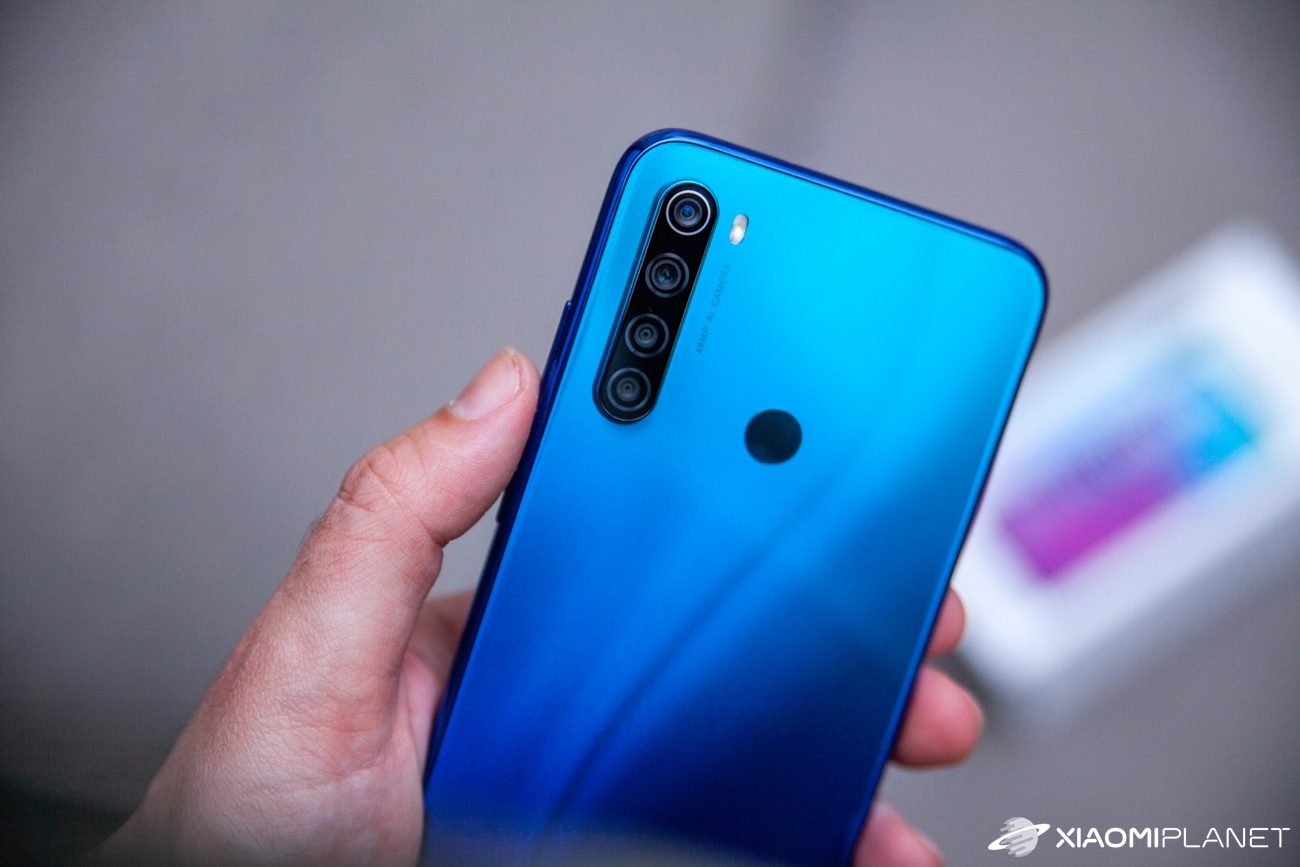
The back features a significant upgrade over its predecessor, and that’s immediately the set of four rear cameras. They protrude from the device body in a single shared module in the top-left corner by approximately 1-2 mm.

Right next to it you’ll find a dual LED flash and the 48 MP camera label, which is also present this time. Below, you won’t miss the standard and proven fingerprint reader. On the modern, gradient back panel, the Redmi logo and the mandatory manufacturing and recycling information are also included.
Verified 1080p IPS panel
Both the display dimensions and resolution are also identical to the previous generation. The verified 6.3″ IPS panel offers a resolution of 2340 x 1080 pixels (Full HD+) and an aspect ratio of 19.5:9, with a rounded teardrop-shaped cutout at the top. The display has a crisp 401 ppi and covers almost 82% of the front panel. The colors on this display are true-to-life, and viewing angles are very good.


If you still want to fine-tune the color spectrum, this option is available in the settings. We’d have liked to see the maximum brightness improved by a bit more. Users will benefit from this especially in direct daylight. However, readability isn’t exactly bad, and given the price, it’s a solid result. Minimum brightness was also fine—even in total darkness, it didn’t blind.
Slightly upgraded Snapdragon 665
This is a real upgrade over the predecessor in the form of an updated CPU model. Specifically, it’s the octa-core Qualcomm Snapdragon 665 (4 x 2,0 GHz Kryo 260 Gold and 4 x 1,8 GHz Kryo 260 Silver), and in terms of performance the smartphone worked fast and reliably, even with simpler multitasking.


Players of basic mobile games won’t feel any loss of comfort either—graphically demanding 3D gaming titles will only require a slight reduction in detail. Still, it’s a good, battery-friendly processor paired here with the Adreno 610 graphics accelerator. You can check the results of the AnTuTu testing in the gallery above.
Up to 6 GB RAM and 128 GB storage
In the base configuration, you only get 3 GB RAM and 32 GB of internal storage. We received for testing the version with 4 GB RAM and 64 GB of storage, while for sale there are also other versions like 4 GB RAM and 128 storage, and in selected markets also 6 GB RAM and 128 GB of storage. Which version should you choose? It depends on how demanding the user is.


In the base version, the previous generation can already “breathe a little” with the current system. With an eight-core setup and 4 GB RAM, we didn’t notice that, and the smartphone ran smoothly. So if you’re a non-demanding user, you’ll probably be fine with the cheapest base version.
If you want more from the smartphone and need advanced multitasking, it’s better to choose at least the version with 4 GB RAM. And what about storage? After the first boot, Android with the MIUI skin will take more than 11 GB from your internal storage.
Standard, proven, and fast fingerprint reader
Device security is handled by a standard fingerprint sensor. It’s placed on the back, it’s fast, and it recognizes your fingerprint in a fraction of a second.

This is a proven sensor, and we’re glad Xiaomi keeps this option. Face unlocking via the front camera is also available, though the question is how safe this feature is on these devices.
Android 9 Pie and now already MIUI 11
The system is fairly up to date— the budget-friendly Redmi Note 8 runs Android 9 Pie and should also receive the latest Android 10. It’s also doing very well on security: the phone includes Google’s October security patches, so all that’s missing for now is the November update, which should arrive any moment now.


What delighted us in the editorial team even more is support for the manufacturer’s new overlay version, specifically in the stable MIUI 11.0.3.0 version. The update to version 11 arrived during our testing. This is a well-optimized device that also brings a new font, a fully featured dark mode, and the digital balance or Google Family Link-style parental control functionality.


A set of four good cameras
On the back, you’ll find four cameras at once, and each one has its own primary purpose.
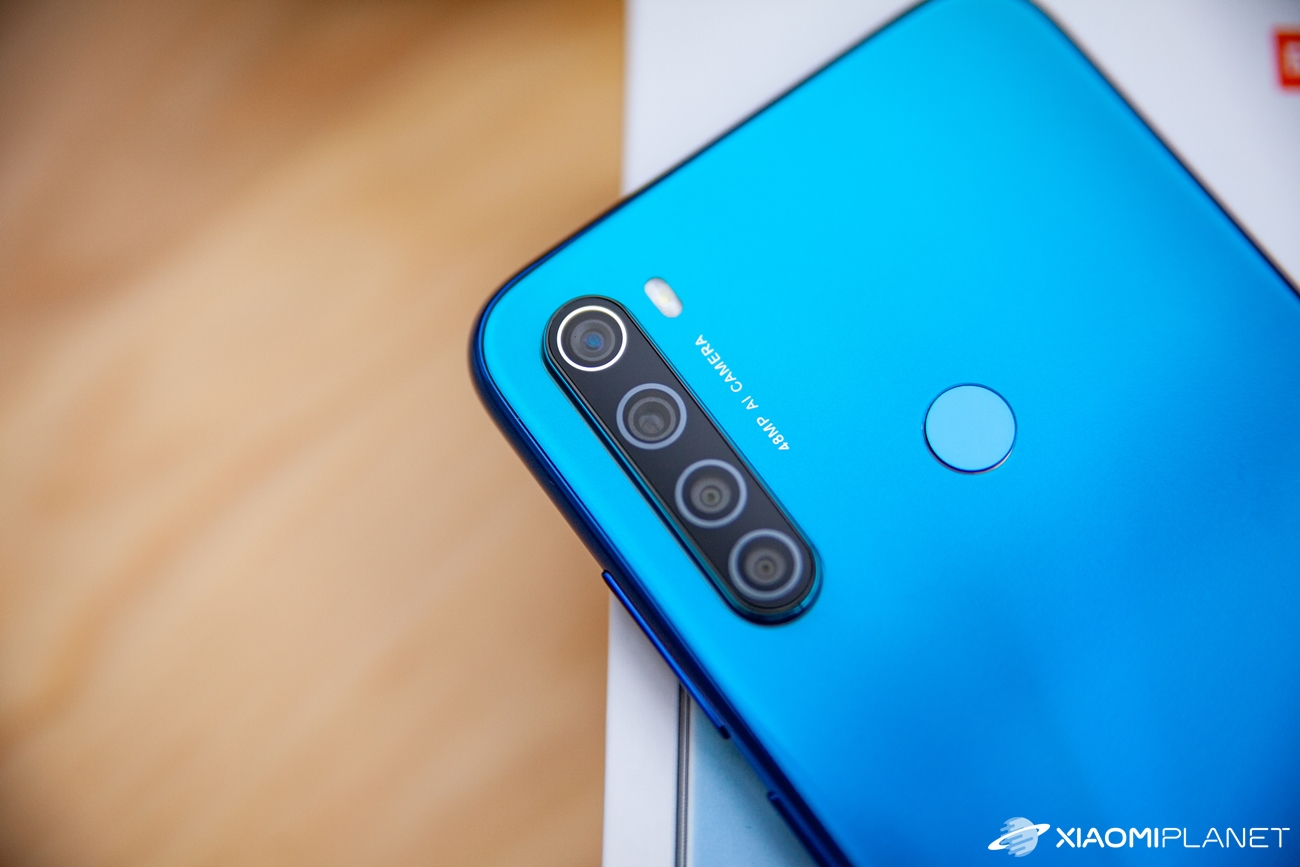
The main sensor is a well-proven 48 MPx sensor (f/1.8). It’s complemented by a quality 8 MPx wide-angle sensor (f/2.2). There’s also—surprisingly—useful 2 MPx “macro” lens (f/2.4), and the setup is completed by a 2 MPx sensor for blurring the background, i.e., the “bokeh” effect (f/2.4).


You can record video in up to 4K (30 fps), but higher stability is provided by 1080p resolution. The front camera has 13 MPx (f/2.0), and it still sits in the well-known cutout at the top of the display.
It’s clearly visible that the camera setup has been improved compared to the predecessor. Daylight photos look great and sharply detailed—whether you’re capturing 12 MPx shots using pixel binning from the 48 MPx sensor or taking “macro” photos. The wide-angle lens also didn’t disappoint and can add a genuinely different perspective. A vivid color spectrum and a sufficient amount of detail in this low price segment are really good news.
Original photos in full resolution are available in the link below.
In the gallery, we bring you a preview of photos taken in daylight, photos taken in poor lighting conditions, full-featured 48 MPx shots, but also ultrawide and “macro” photos.
A compromise in the form of missing NFC
The Redmi Note 8 continues the trend set by its predecessor, and when it comes to connectivity, we’re still looking in vain for an NFC chip. Only a model aimed at the European market, labeled Redmi Note 8T, got NFC. So with the standard “eight,” you won’t be able to pay via Google Pay.

In terms of features, Wi‑Fi 802.11 a/b/g/n/ac is standard, along with older Bluetooth 4.2 LE. You’ll also get GPS, A‑GPS, GLONASS, an infrared port, FM radio, and support for USB OTG if a USB Type‑C connector is present.
If you buy the global version of the smartphone, you won’t be missing local 4G networks for fast connections either. Specifically, you’ll get these bands: 1(2100), 2(1900), 3(1800), 4(1700/2100), 5(850), 7(2600), 8(900), 20(800), 38(2600), 40(2300).
Redmi Note 8 also includes a special speaker feature – self-cleaning. You can find this feature in settings, in the Clean speaker section.
The feature can use high-frequency tones to clean the speaker of dirt like dust. During this process, the speaker emits sound for 30 seconds, effectively blowing air out of the speaker. It can even blow out a candle.
Kept 4000 mAh + fast charging
Inside the device there’s a battery with unchanged capacity of 4000 mAh. The phone supports 18W fast charging, but to use it you’ll need the appropriate charger. Even so, we rate the battery life very positively. The smartphone lasts not only a full working day, but by evening it still has a reserve of 30 – 40% battery capacity.


A full workday in our editorial team involved active use of social networks, a display brightness of around 70%, one-hour phone calls, similar watching of 1080p videos, and occasional gaming.
Final rating: A lot of music for not much money
For the low price, you’re really getting well-made, functional equipment here, with the compromise being the missing NFC. Great photos are complemented by a fast MIUI system and solid features, along with excellent battery life on a single charge.


Best coupons from Gearbest
I want a discount on the Redmi Note 8
For more demanding use, we recommend choosing the version with a higher RAM value. In its price category, though, it’s again a smartphone with an excellent price/performance ratio and will definitely catch the attention of many customers in the pre-Christmas market.
Don’t miss the best coupons 📩
Subscribe and we’ll email you new coupons before they expire. We only send it once a month — no spam.