
- Xiaomi has officially started selling the SUV SkyNomad N70 Pro, N70 Max and N90 Max with an extended range (EREV).
- Prices are 209,900, 239,900 and 269,900 yuan, i.e., roughly €27,000, €30,900 and €34,700—about 20 to 30 thousand yuan less than in the pre-sale.
- N70 Max goes electric for 505 km and a total of 1,461 km, N90 Max up to 1,705 km.
- After import into Slovakia, N70 Pro would come to about €43,000 and N90 Max to €54,000, based on our calculation.
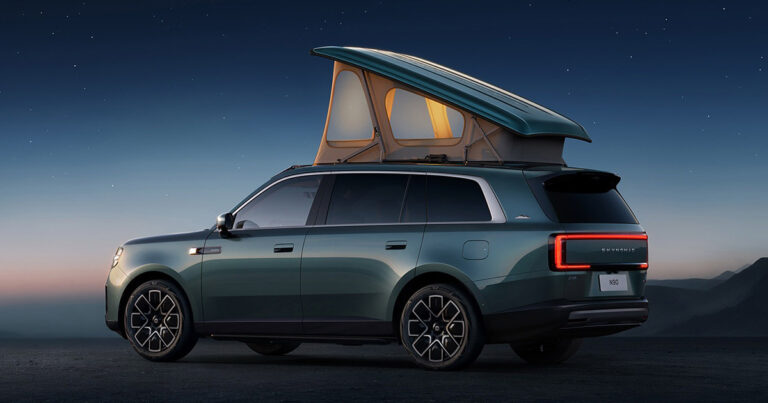
- The N90 Max Studio version comes with an electrically retractable roof from the factory, under which you can build a setup.
After the 18 Fold phone and the Pad 9 Pro Max tablet, Lei Jun dedicated the longest segment on cars at today’s autumn conference. The SUV family Xiaomi SkyNomad (in China 澎程, Pengcheng), which we described in detail in July, has now received final pricing and sales have started.
Xiaomi doesn’t build it like a classic SUV or MPV, but as a „home on wheels” with a fully flat floor and a flexible interior. All the facts mentioned in the article were said during the Xiaomi live stream.
SkyNomad N70: a five-seat SUV with five meters of length and six colors
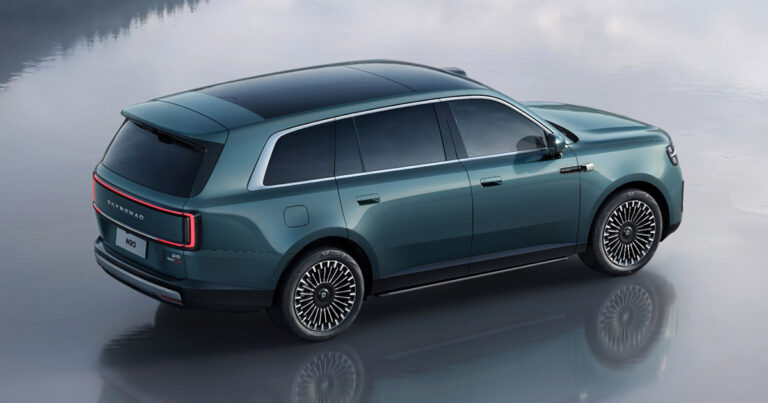
A new highlight of the evening is the smaller model SkyNomad N70: a five-seat SUV in the mid-to-upper class with a length of 5 meters, a width of 2 meters, and a wheelbase of about 3 meters—so it’s roughly comparable in size to the Li L6. The design borrows family cues from the SU7 and YU7: Dragonfly headlights with a 624-meter beam distance and a 180-degree angle for the lights meeting at oncoming traffic, frameless rear-view mirrors, a pebble-shaped lidar, and a slanted D-pillar with a hint of a fastback.
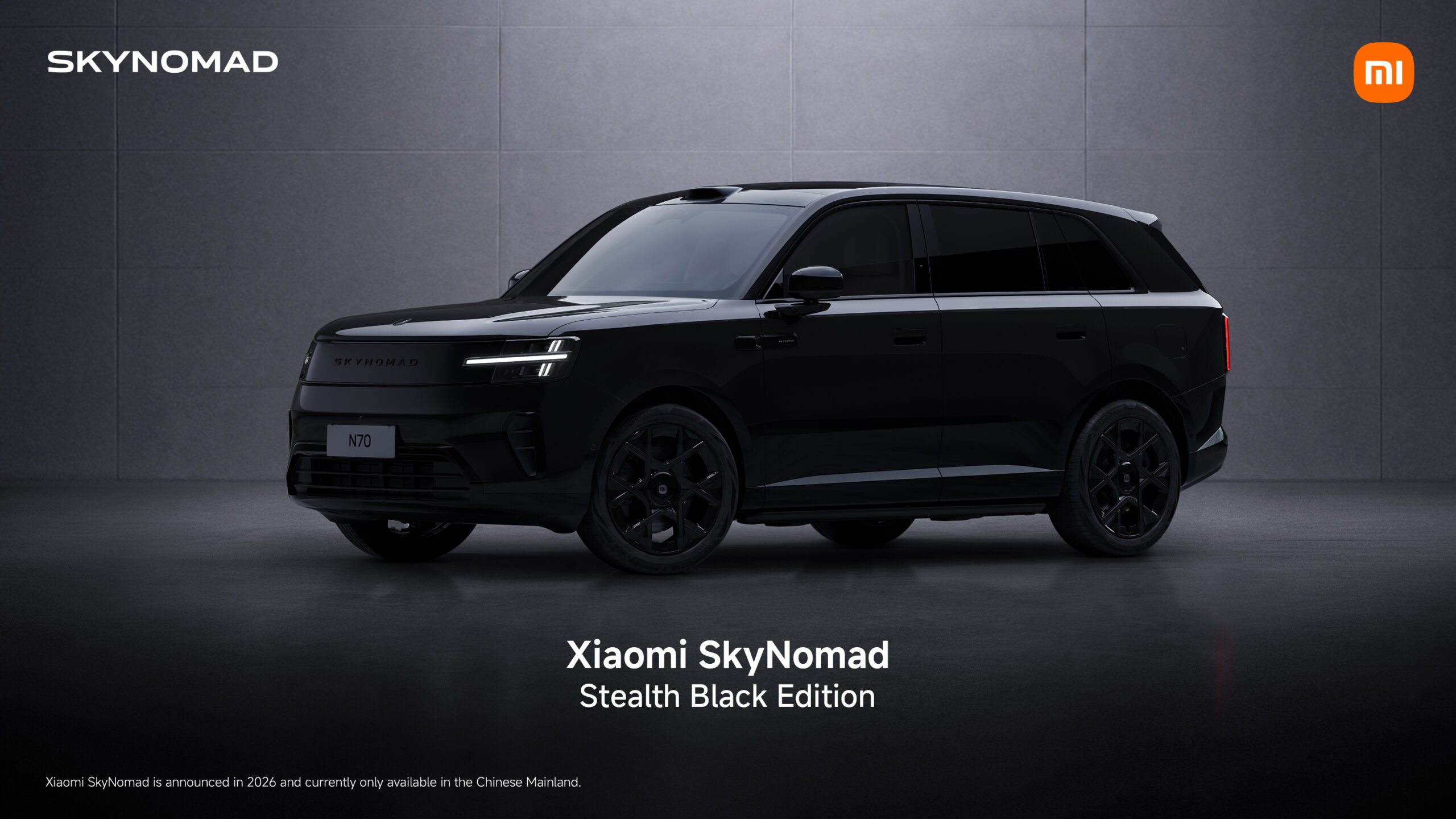
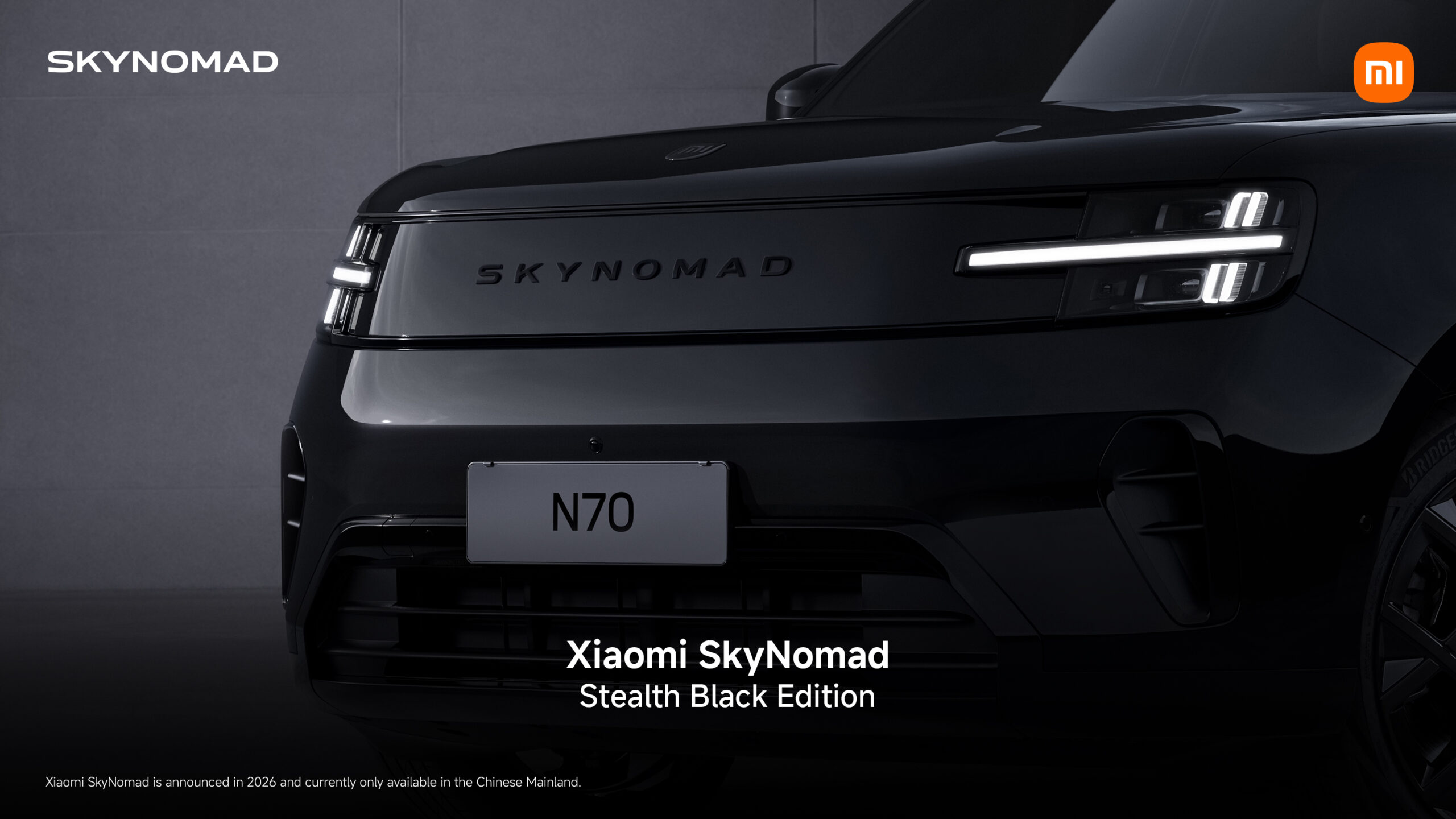
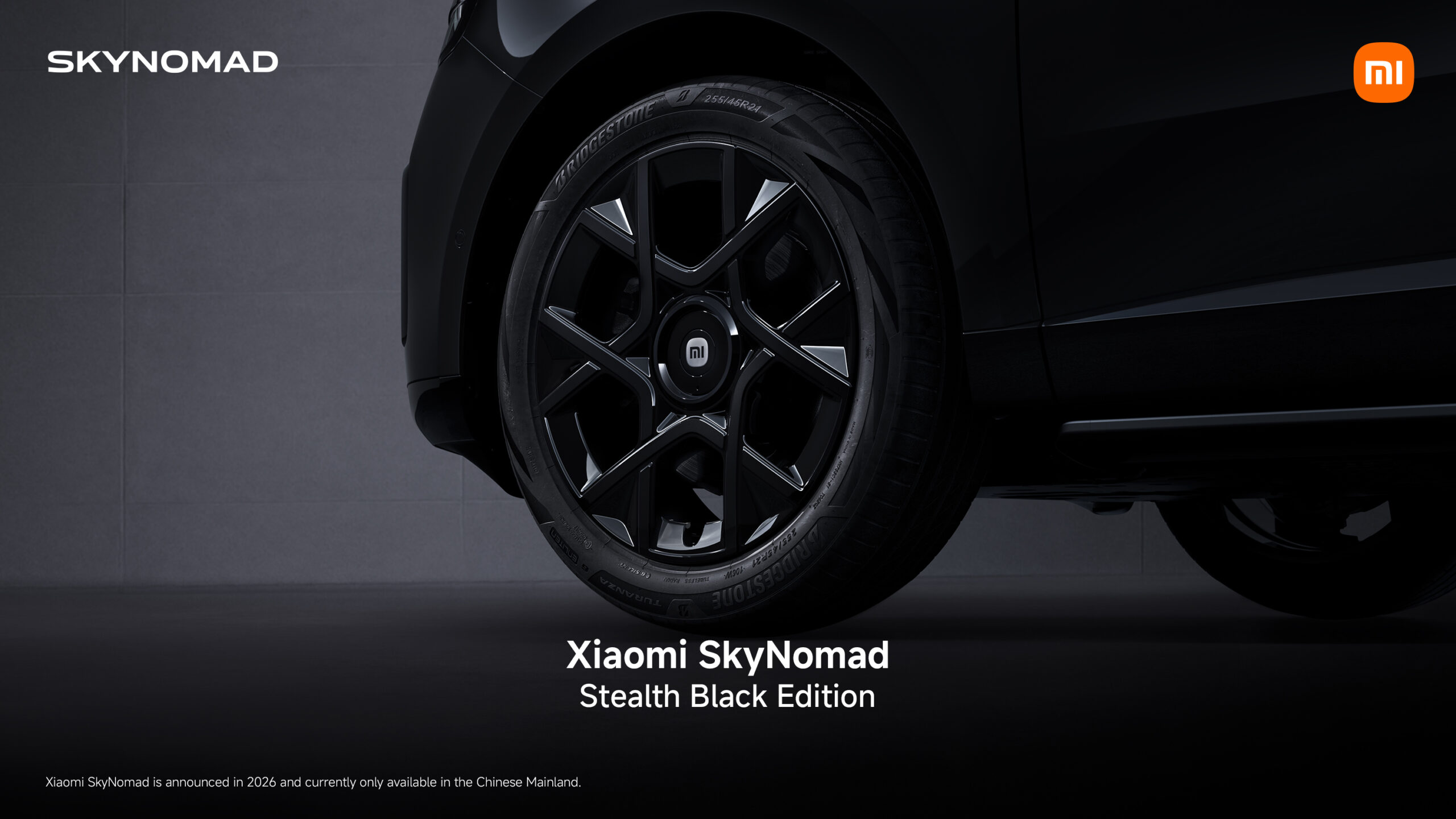
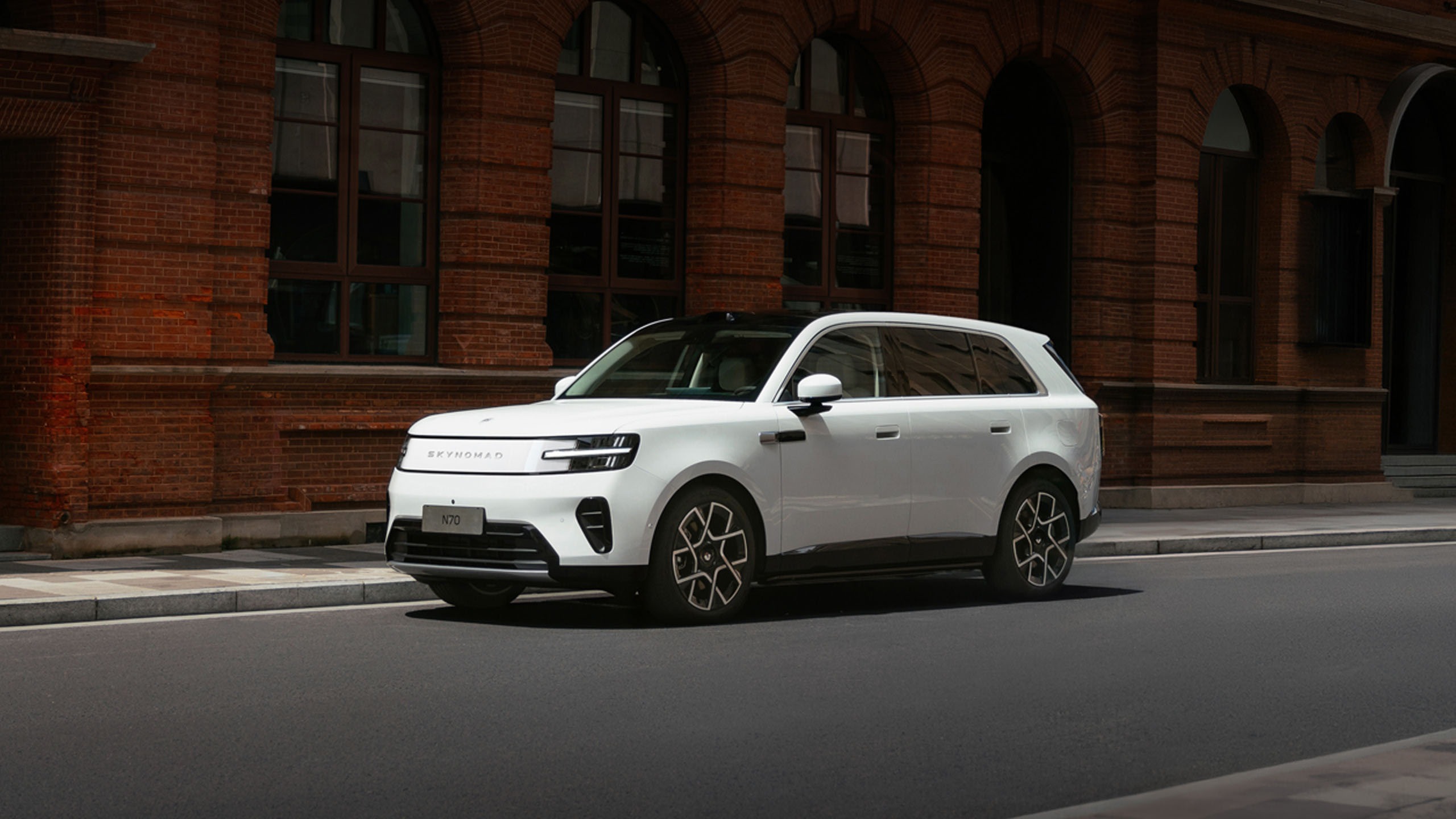
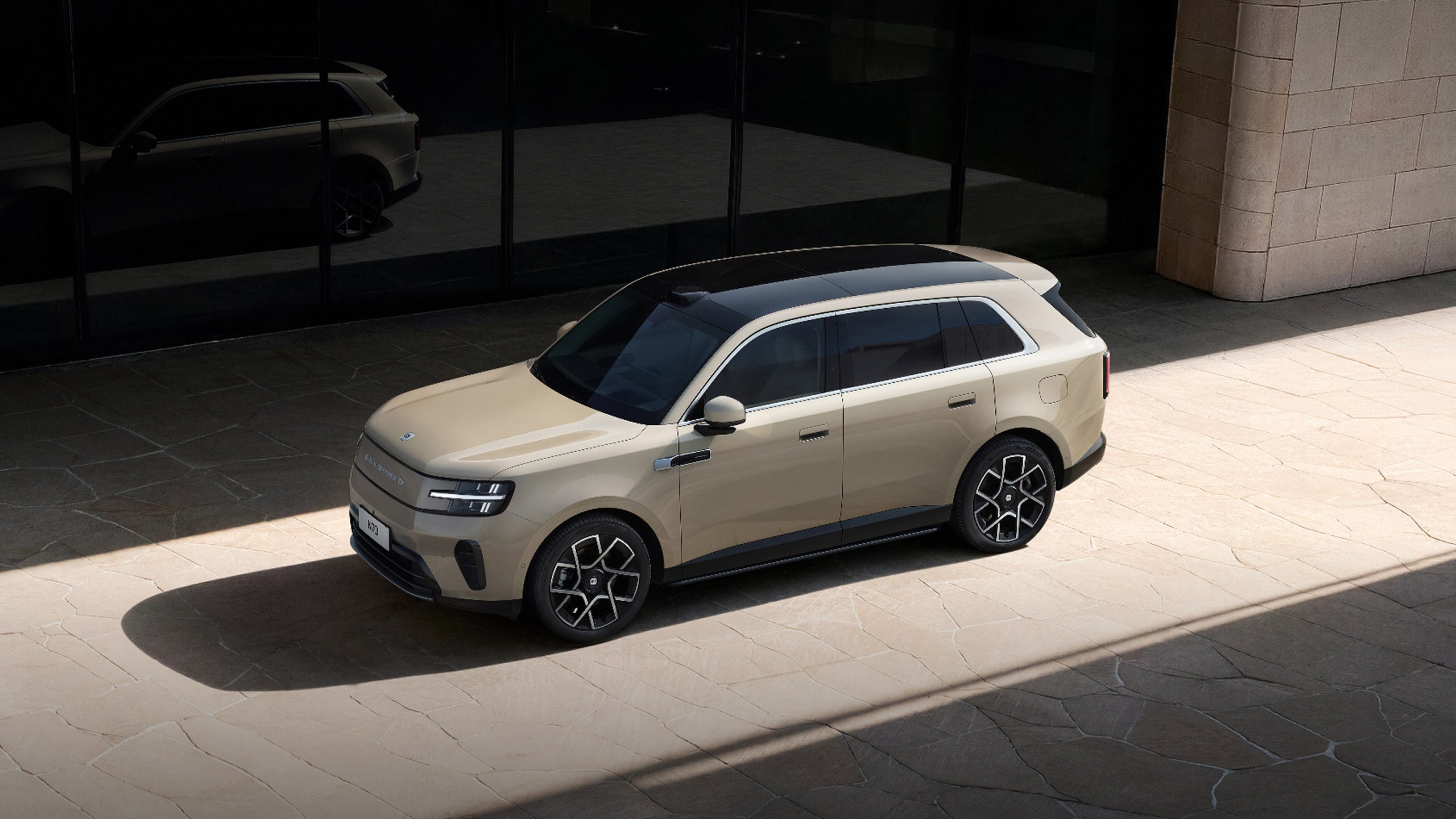
Xiaomi offers six colors: Butterfly Valley Blue (blue), Distant Mountain Green (green), pearl white, volcanic grey, obsidian black, and a new neutral khaki. The interior comes in three shades (sand beige, mocha brown, and midnight black).

The cabin has 6,14 m² of glazed area, laminated solar glass in the front, dark glass in the rear, and a panoramic roof with a fully functional physical roller blind. The air conditioning is handled by a heat pump with 12 vents, including separate vents in the B-pillars for the second row; there are also PM2.5 and air-quality sensors, and 95 % of the surfaces your hands touch are soft-padded and also suitable for babies.
A flat floor of 2,58 meters and more legroom than in a Rolls-Royce
The main advantage of the N70 is space. The floor is completely flat over the 2.58-meter length with a slope of just 2.95 degrees; the usable area reaches 4.01 m², and the floor includes five long rails—the longest is 1.56 meters. The second-row seats slide by 600 mm.
In its standard setup, passengers in the back get 1.01 meters of legroom and 1.021 meters above their heads. After sliding the seats back, you get up to 1.41 meters of legroom—according to Lei Jun, 50% more than in comparable cars and more than in the Rolls-Royce Cullinan. Up front, you can choose between massage, rotating, or zero-gravity seats. As standard, there’s a sliding center console with a table in three configurations.

The trunk offers 1,203 liters as standard, which Xiaomi says is 1.5 times more than the Tesla Model Y—you can fit ten suitcases at once. After folding the second row, it grows to 2,425 liters. In the “seats facing each other” mode, there’s 1,687 mm between passengers, and the trunk still holds 662 liters. The rear doors open to nearly 90 degrees, and with the low sill plus electrically extendable step assist, getting in is like entering a limousine.

Xiaomi calls it a „refrigerator, TV, and sofa package”. A 9-liter fridge with its own compressor fits ten cans and, thanks to flyback technology, uses less than 1 kWh per day—so it can run continuously. The back 21.4-inch 3K display with 800 nits brightness and a blue light filter lets you watch from 0.76 to 1.15 meters away.
The second-row seats can be electrically reclined up to 135 degrees and come with ventilation and heating. The front adds a 16-point massage. The Pro version has 14 speakers plus a 200 mm subwoofer. Max gets Xiaomi StarString audio with 25 speakers in a 7.1.4 setup, delivering a peak power of 4,890 W—tuned by Xiaomi over 1,440 hours.
Drivetrain: 505 km electric, 1 461 km total, and 92-octane gasoline
Both N70 variants use the Xiaomi Kunlun Super EREV system, where the 1.5-liter turbo engine doesn’t drive the wheels—it’s used only as a generator. N70 Pro has a rear electric motor rated at 210 kW, accelerating from 0 to 100 km/h in 7.9 seconds, and an LFP battery with a 52 kWh capacity gives it 351 km of pure electric range according to CLTC, for a total of 1,351 km.
N70 Max has two motors, all-wheel drive, 310 kW, reaches the century mark in 5.5 seconds, and uses an NMC battery with 76 kWh—meaning 505 km on electricity, which Xiaomi says is the most among all extended-range vehicles, plus 1,461 km combined. Fuel consumption on empty battery is from 5.7 L/100 km.

From 20 to 80%, the battery charges in 18 minutes. In 15 minutes, Max tops up 310 km and Pro 220 km of range—so you can use it like a pure electric vehicle with charging once a week. The generator runs so quietly that, according to Xiaomi, it adds less than one decibel of noise. It runs on 92-octane gasoline and, after the first inspection, is serviced once every three years or 30 000 km.
The chassis features double wishbones up front and a multi-link rear axle with hydraulic mounts. Max also adds air suspension with adaptive dampers as standard. Turning radius is 5,67 meters, and the braking distance is 100 km/h for 38,25 meters. Xiaomi, a Beijing automaker, also emphasized winter performance: in freezing temperatures, the car will keep 66 % of its electric range and can start at minus 40 °C.
Safety and intelligence: NVIDIA Thor, lidar, and a 8 year battery warranty
The full N70 lineup gets, as standard, a flagship Qualcomm chip for the cabin and NVIDIA Thor-U for Xiaomi HAD’s assistance system—plus lidar, a 4D millimeter-wave radar, 12 ultrasonic sensors, HD cameras, and dual 5G. The HyperOS cabin with five interconnected displays has the Super Xiao Ai assistant, which controls 95% of the car’s functions by voice, including interior adjustment. It also features the second-generation robotic dashboard mascot that turns toward the voice.
The car has 12 interfaces for an ecosystem, 11 power outlets, and five magnetic holders. It also includes the first in-car transmitter for group trips and a magnetic point—when you place your phone on it, it turns into a remote control for seat and climate control.

The body uses 93 % high-strength steel and aluminum. Steel with strength of 2 200 MPa on 14 critical points, an integrated protective cage, nine airbags, and nine collision sensors. Standard equipment includes maneuvering lights for night driving, wading up to 650 mm with emergency floating, during which the cabin stays dry for several minutes, and stability control for a two-wheel defect up to 160 km/h.
The Xiaomi Dragon Armor battery has 18 layers of protection; it survived a 500 J impact on the bottom, submersion, and even being punctured with a nail. Xiaomi also provides a warranty on both the battery and the generator for 8 years or 160,000 km. If it catches fire due to a manufacturing defect, Xiaomi will replace the entire car with a new one. In the event of a fire after an accident, it will cover the difference above the insurance cap.
N90 Max: a seven-seat flagship SUV for 269 900 yuan, and a version with a retractable roof
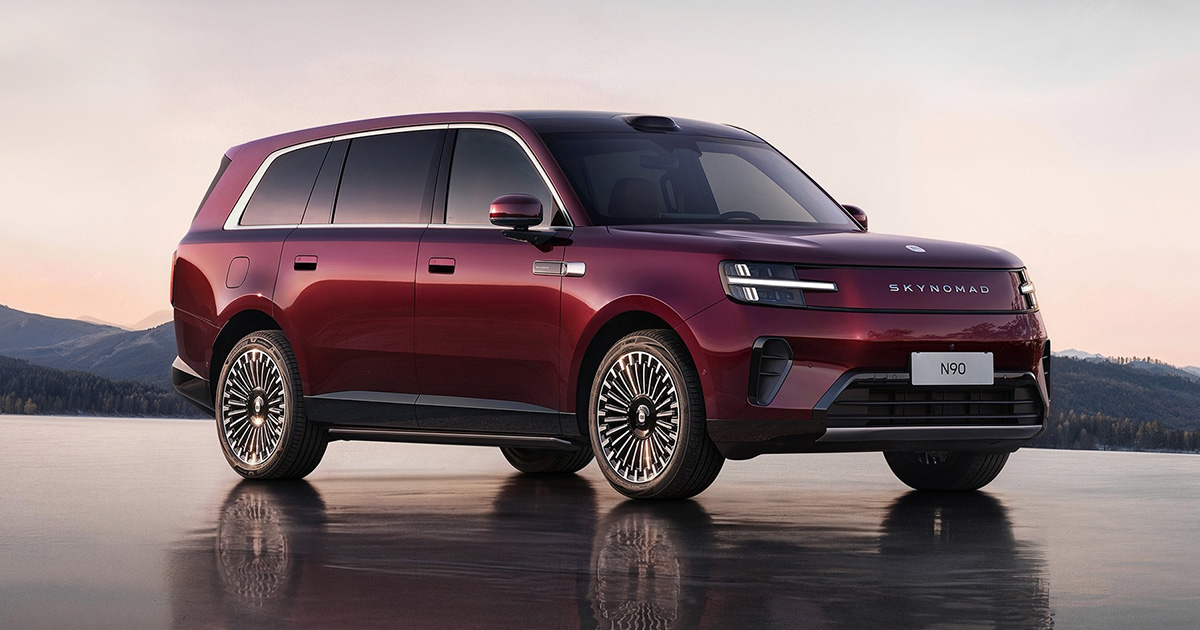
The larger SkyNomad N90 Max with a length of 5.28 meters, seven seats in a 2+2+3 layout, and rotating front seats have been described in detail already; today it’s also got its seventh color, a deep wine-red. There are factory 21-inch Bridgestone quiet tires and the final price.
The drive is dual-motor with 310 kW, 0–100 in 5.9 seconds, 465 km on electricity and a total of 1,705 km overall with consumption of 6.26 l/100 km on a depleted battery. Lei Jun showed a real test: his colleague covered 1,030 km from Shanghai to Beijing on a single tank and charging under highway limits, and at the destination there were still 54 km left, with the car covering 323.6 km purely on electricity. The body has 2,200 MPa steel at 16 points, a one-piece stamped door-frame with a 3.3-meter length, a roof that supports 14 tons, 12 airbags, and at the back an additional solid-state lidar for parking.

The new thing is the N90 Max Studio version, the first production SUV in China with an electrically retractable roof integrated directly from the factory. In the stowed position, the car grows by only 100 mm, and the drag coefficient stays at 0.245. When extended, it creates a two-level space: the upper deck is 2.11 × 0.985 meters with mesh screens, air conditioning, lighting, and charging. Total ceiling height reaches 2.29 meters, so you can stand inside and change clothes. The construction passed the rollover test at 44.7 km/h without separation and 10,000 opening/closing cycles. Xiaomi hasn’t announced the Studio price yet at the conference.
China prices: cheaper than in the pre-sale
Lei Jun admitted that everyone hoped for a price under 200,000 yuan, but the costs didn’t allow it—so the base N70 is not even being sold. N70 Pro costs 209,900 yuan (about €27,000). Compared to the competition at 239,800, it has a battery that’s 15 kWh larger, an electric range that’s 116 km longer, and a standard heat pump. N70 Max costs 239,900 yuan (about €30,900), which is 20,000 less than in the pre-sale. For an extra charge over the Pro, you get 4×4 drive, an additional 154 km of range, an air suspension, a head-up display, and an audio system with 25 speakers. N90 Max comes in at 269,900 yuan (about €34,700), which is 30,000 less than in the pre-sale.
On top of that, Xiaomi is adding bundles at launch: for Pro worth 63 000 yuan, for N70 Max 67 000 and for N90 Max up to 81 000 yuan. They include Nappa leather, 8 000 yuan vouchers for wheels and 3 000 for paint, a lifetime free HAD assistance system, rotating front seats for the N90 Max, and two zero-gravity seats in the second row for free. Equipment bundles are also discounted: for N70 Pro—audio, HUD, a fridge, and dimming mirrors worth 16 000 yuan for 6 000; for N90 Max—electric doors, a rear TV, power steps, and a fridge worth 31 000 for 20 000. The start of deliveries wasn’t mentioned during the conference, but Lei Jun had already said earlier that the first N90 Max units are in showrooms and will be delivered in one to five weeks.
How much would SkyNomad cost in Slovakia?
Xiaomi currently doesn’t sell cars in Europe, and an official launch is expected in year 2027 and will begin in Germany. If you want SkyNomad sooner, you’ll need to go via individual import from China and add shipping, customs duty (clo), VAT (DPH), and Slovak approval to the Chinese price. We calculated it for all three versions at an exchange rate of roughly 0,129 € per yuan.
Shipping by container or RoRo ship from China to a European port, insurance, and transport to Slovakia will cost roughly €3,000. Customs duty is paid from the car value including shipping, and then VAT 23% is calculated from the price including shipping and customs duty. On top of that, you need to add the individual vehicle approvals in Slovakia, because SkyNomad does not have European type approval: technical inspection, emissions, any headlight adjustments or software changes, and fees will come to about €1,500 to €3,000. The registration fee for plug-in hybrids, thanks to the 0.2 coefficient, is only around €200 even if the power exceeds 210 kW.
The biggest unknown is customs duty. The EU’s standard customs duty on passenger cars from China is 10%, but for purely electric cars, from October 2024 there are also countervailing duties depending on the brand: BYD is together 27%, Geely 28.8%, SAIC with MG 45.3%, and other collaborating brands together 30.7%. Xiaomi could not participate in the investigation because at the time it started, it had not sold a single car yet—so, according to SCMP, it falls among non-cooperating companies with the highest rate, i.e. 45.3% together, unless it secures its own rate as a new exporter or a price undertaking.
SkyNomad is a range-extended car that, for customs purposes, falls under plug-in hybrids—so these countervailing duties do not apply to them today. However, according to the portal electrive, the European Commission is preparing customs duties also for Chinese hybrids starting June 2026. So if you place an order that reaches Europe a few months from now, you should expect a similar rate to that of electric vehicles. That’s why in the table we list two scenarios: today’s 10% and 45.3%, which Xiaomi, as a non-cooperating brand, would receive if the duties are extended to hybrids.
| - | N70 Pro | N70 Max | N90 Max |
|---|---|---|---|
| Price in China | 209 900 ¥ (27 000 €) | 239 900 ¥ (30 900 €) | 269 900 ¥ (34 700 €) |
| Shipping and insurance | 3 000 € | 3 000 € | 3 000 € |
| Approval and registration | 2 500 € | 2 700 € | 2 700 € |
| Customs duty 10 % (current status for hybrids) | 3 000 € | 3 390 € | 3 770 € |
| VAT 23 % on cle 10 % | 7 590 € | 8 580 € | 9 540 € |
| Total with cle 10 % | approx. 43 000 € | approx. 48 600 € | approx. 53 700 € |
| Customs duty 45.3 % (if duties are extended to hybrids) | 13 590 € | 15 360 € | 17 080 € |
| VAT 23 % on cle 45.3 % | 10 030 € | 11 330 € | 12 600 € |
| Total with cle 45.3 % | approx. 56 100 € | approx. 63 300 € | approx. 70 100 € |
If Xiaomi secured a rate for collaborating brands (together 30,7%), N70 Pro would come out to roughly 50 700 €, N70 Max to 57 200 €, and N90 Max to 63 300 €. The amounts are estimates. In reality, they may differ depending on whether the Chinese exporter sells the car without domestic 13 % VAT, what margin the intermediary charges, and whether individual approval passes without major changes—which is not guaranteed for Chinese cars with their own software and driver-assistance systems. When Xiaomi officially comes to Europe, you should expect a higher price due to the importer’s margin, EU-wide homologation, and a service network. As soon as the option to import SkyNomad becomes available, we’ll let you know.
To get more updates from the world of Xiaomi, keep following our Xiaomi Planet website. Join our Facebook group, where we build an active community and help each other out. Subscribe to our Telegram as well, where we add the best deals and coupons from China every day.
Don’t miss the best coupons 📩
Subscribe and we’ll email you new coupons before they expire. We only send it once a month — no spam.