
We already informed you that Xiaomi unveiled its completely first SU7 electric car on March 28, 2024. Now, based on a popular review by Telescope望远镜, a well-known YouTube channel focused on cars from China, we’re bringing you a detailed summary of everything you should know about the first electric car made by a phone manufacturer anywhere in the world.
Get the latest Xiaomi SU7 articles in Telegram too
Which model is being tested?
- Xiaomi SU7 Max
- 101 kWh 800 V
- 2205 kg, 673 HP, 4WD
- 680 km WLTP (range according to the European test cycle)
- Price (in China): 42 000 $ / 39 000 €
Xiaomi SU7 is a sporty, battery-powered sedan with traditional proportions. Even though the design may seem suspiciously familiar at first glance and look similar to Porsche, the Xiaomi SU7 is taking a different path in several ways—which we’ll get into in the next few lines.
Refined interior and great visibility
When you “start up” the Xiaomi SU7, the instrument panel display lights up and flips up. The steering wheel looks and feels very similar to the one in Porsche. That similarity doesn’t necessarily have to be seen as entirely negative. With Xiaomi’s lower price, you can own a “cheap” Porsche.

From the cabin of the electric car, thanks to the low front end and the thin A-pillar, you can see right ahead toward the hood. The forward view—i.e., how well the driver can see the road in front of the car—reminds the YouTuber of sports cars with a mid-mounted engine, which have a low driver seat position and wide fenders. The driver then feels like they’re “in the middle of the action,” and among other things, it leads to better handling.

Infotainment is what sets the SU7 apart from other EVs
The SU7’s interior is primarily designed for the driver, which shows in the layout of the controls and the intuitiveness of the infotainment system. In real life, it looks insanely good—even by Chinese market standards, which already has very strong players in the software space.

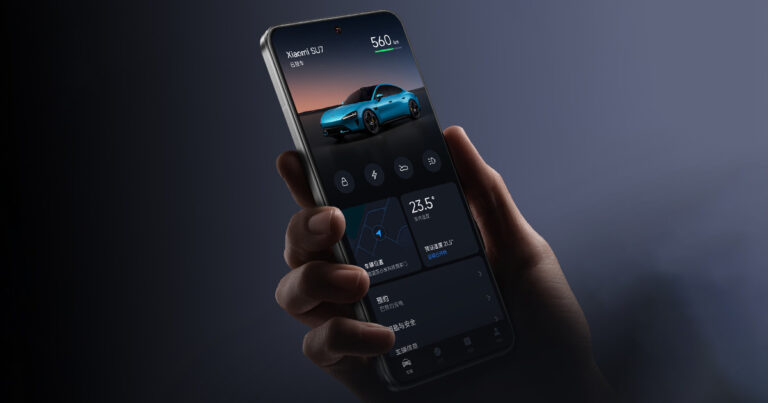
The system isn’t only “CarPlay on steroids“, but thanks to real-time smartphone screen mirroring on the main touchscreen display with 60 fps, it offers full integration of your mobile phone with the vehicle system. That means users can use their apps just as comfortably as if they were holding the phone in their hand.

Tablet holders are just the tip of the iceberg. They’re not just passive accessories, but are fully integrated into the vehicle’s system. They also let rear passengers control various vehicle functions, such as air conditioning, multimedia content, or even navigation.
Just mount a tablet on them and you get an interior in the SU7 (almost) like in an S-Class. As we announced in our article about the Xiaomi SU7 introduction, Xiaomi also integrates app-based connectivity with iPads. Just download the app from the App Store and the iPad is fully integrated into the car’s system. Besides iPads, of course, they also support tablets from Xiaomi—specifically the latest Pad 6S Pro.

The SU7 comes with a lot of physical controls, which is a real rarity in the current trend toward touchscreen displays. Thanks to the magnetic fastening system, you can customize the interior exactly the way you want. This opens the door to attaching accessories like a smartphone holder or other add-ons.

Rear seats
When you look at the back of the Xiaomi SU7 cabin, it’s clear how modern technology and design can work together to improve passenger comfort. Just like in the front part of the vehicle, you can also feel the focus on innovation in the rear.


Although the SU7 isn’t presented as a vehicle aimed at the luxury limousine segment, it offers rear passengers surprisingly comfortable space—something we’d usually expect from larger vehicles. In his review, the YouTuber says that even though the legroom and headroom in the back aren’t at the very top tier, it provides SU7 enough comfort level.

Besides the rear trunk, there’s also a 100-liter “frunk”
Frunk (front trunk), a combination of the English words “front” and “trunk”, is the name Tesla introduced back in 2012. Thanks to the absence of a traditional combustion engine in the front of the vehicle, manufacturers can use this space to add extra storage. Xiaomi SU7 brings the same idea into practice as well, offering a “frunk” with a capacity of more than 100 liters.

In his review, the Telescope reviewer mentions that although the shape of this front trunk may seem unconventional, it’s big enough for you to store carry-on luggage. You’ll also appreciate it when stowing the charging cable. The frunk will especially please those looking for extra space that isn’t available in traditional cars (and not in some EVs either).
Impressive driving dynamics
During a test drive, the YouTuber highlights that the SU7 delivers driving dynamics that could compete with more expensive models on the market—for example, with the less flashy Model 3. Thanks to its electric drivetrain and a low-mounted battery, the SU7 has a low center of gravity (like other EVs), which improves stability and handling.

This configuration lets the vehicle take corners with less body roll and gives the driver more confidence during fast driving. During testing, the YouTuber compares the car’s ride and handling to a standard feel you’d find, for example, in “Audis”. Wind and road noise from inside could be better isolated, but when it comes to outside noise, Xiaomi did a good job.
NVIDIA chips and ADAS systems in practice
One of the most interesting parts of the review points out that the vehicle uses two NVIDIA Orin chips. These form a powerful foundation for advanced driver-assistance systems (ADAS) and autonomous driving. They allow the SU7 to deliver advanced functions like predictive steering and object recognition, with a huge computing capacity to process data from multiple sensors in real time.

With the SU7, questions arise about potential future software updates that could further expand its autonomous capabilities. Tests showed that the highway cruise control system is usable, but (for now) its performance doesn’t reach the level of more expensive car models.
Is the SU7 price-competitive as an EV?
Xiaomi, with the SU7 model, has entered the electric vehicle market promisingly and shows that even a (formerly) smartphone manufacturer can bring innovation and quality to the automotive industry. The vehicle price works out at from $30,000 for the base SU7 model up to $42,000 for the reviewed Max version. In a separate article, you can find the exact specifications of all SU7 models.

A direct price conversion to euros can be misleading. A useful reference point is comparison with cars available for sale in China and in the EU. A great example is the mentioned Tesla Model 3. Its price in China starts at 245 900 yuan, while in the EU its equivalent price is roughly 31 500 €, but it’s sold a bit more expensively.
So what could the price range of the Xiaomi SU7 look like in Europe? To find out, we’ll need to wait a bit longer—at least until 2026–2027.
Final assessment
The SU7 is reviewed as surprisingly good and outperforming its price category. The reviewer highlights the fact that even though this is Xiaomi’s very first car—originally a smartphone maker—SU7 is a “normal” car without any major flaws that often catch new automakers off guard.
In connectivity, it currently deserves the title of the best car in the world. In the end, we get to the mentioned “scandalous” design, which instead of Xiaomi’s signature style strongly resembles the Porsche Taycan.

Unfortunately, that’s a shame, because the features and technology this EV offers will appeal to its customers even without copying the design of other flagship models. Still, we assume that the Chinese designers and engineers know why they did it this way.
Xiaomi has shown its own ecosystem in the automotive industry, which we see as a direction Xiaomi will continue to take in automotive.
Full video review Xiaomi SU7:
For more great updates, discounts, and offers, follow Xiaomi Planet, sign up for news, and join our Facebook group as well, where we build an active Xiaomi community.
Don’t miss the best coupons 📩
Subscribe and we’ll email you new coupons before they expire. We only send it once a month — no spam.